


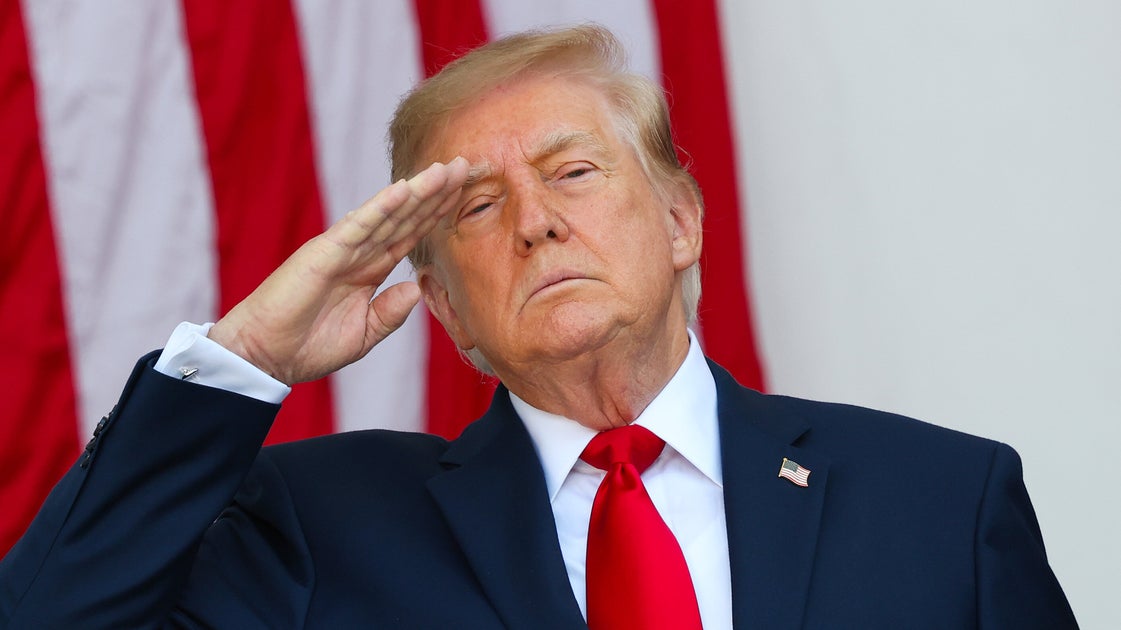
My father rarely talks about his time in Vietnam. Born within two weeks of President Donald Trump in 1946, he was drafted and served in the United States Army during the war at a time marked by severe violence, casualties, destruction and low morale.
Trump, by contrast, received five military draft deferments during the Vietnam War and never served in the armed forces. Perhaps that is why I was so struck by the president’s Veterans Day speech on Wednesday ― and particularly his use of violent, graphic language and imagery.
While honoring veterans at Arlington National Cemetery, he did not shy away from going into the gory details of the injuries some service members sustained in the line of duty, describing “shattered bones protruding from his absolutely mangled leg and arm” and “horrific burns across his entire body and all over his face.”
It’s a familiar pattern for the president. In his first inaugural address in 2017, he painted a bleak picture of life for some in the United States, promising to end what he called the “American carnage.” At a 2024 campaign rally at Madison Square Garden, he described the 2016 killings of two teenage girls by MS-13 gang members in grisly detail:
“They didn’t shoot them. They knifed them, and they cut them into little pieces because it was so painful. Perfect, perfect, young, beautiful girls were cut up into little pieces by knives.”
UCLA researchers Nikita Savin and Daniel Treisman analyzed 99 of Trump’s speeches from April 2015 to June 2024 and found an upward trend in violent vocabulary. Compared with other U.S. and world leaders, they said they found Trump’s frequency of violent language “exceeds that of any other politician in a democracy that we studied.”
“I think my general reaction is this is Trump being Trump,” Jennifer Lawless, a professor of politics at the University of Virginia, told HuffPost of the Veterans Day remarks. “He tries to be provocative. He tries to be shocking. He tries to make news, and when he talks about things in unconventional ways or uses graphic imagery, he gets the attention he’s seeking.”
“He’s demonstrated over the last 10 years that there’s no topic that is inoculated from this,” she added. “Prior to him, it would have been seen as unbecoming a president. But he has really changed the way we use language, and I think that this is just one more example of the shock value.”
Dan Cassino, a professor of government and politics at Fairleigh Dickinson University, told HuffPost that graphic language is “a well-established rhetorical tool.”
“In political rhetoric, graphic imagery is used to create feelings of threat or fear, on the theory that threatened audiences are more likely to go along with whatever the speaker says in order to reduce the threat,” he explained. “This goes back to the very earliest work on authoritarian politics in the immediate aftermath of World War II, when scholars argued that perceived threat made populations more willing to cede power to leaders who promised to combat that threat.”
Michael Phillips-Anderson, an associate professor of communication at Monmouth University, said Trump’s graphic framing often casts him in a particular role.
“I think it partially reflects how he sees the world as a dangerous, violent place,” he said. “By describing it in such stark terms, he often explicitly, sometimes implicitly, positions himself as our protector. The idea is if you’re scared by this, he’s the one who can protect you from it.”
Graphic descriptions of bodily injuries also tap into a basic human response.
“Whenever we’re talking about violations of the body envelope, it triggers a disgust reaction,” Cassino said. “This is one of the most elemental responses humans have to outside stimuli, and responses to it are completely outside of conscious control. When something triggers that disgust response, even if we know that it’s not a danger, we avoid it.”
That reaction can add up over time.
“Repeated exposure to violent or graphic language can contribute to increased levels of anxiety, fear and feeling emotionally distressed, especially for people with a history of trauma,” said Hallie Kritsas, a licensed mental health counselor with Thriveworks. “It could perhaps also lead to desensitization over time. Some can become increasingly fearful, and some can start to normalize it. Both of these reactions shouldn’t be dismissed.”

Cassino noted that leaders may find it useful to harness this kind of response ― pointing to anti-abortion protesters’ use of graphic images of fetuses “on the theory that the disgust response is going to overwhelm any reasoned response.”
Of course, the president doesn’t necessarily announce his motives for describing gruesome violence. Experts said there could be a few theories why he does it.
“In some cases, Trump is being strategic in his use of imagery ― the American Carnage speech is a good example,” Cassino said. “He’s using graphic language, evoking fear and disgust in order to try and get permission from the country to do what he thinks needs to be done in order to fix the problem he’s claiming exists.”
“At other times, he’s just playing the room, using lurid detail because it gets a response from the audience,” he said. “In a case like this, where he’s trying to build support for the war in Iran, it’s a bad idea to evoke the horrors of war, it’s going against his general rhetorical goals, but it gets a response, so he runs with it.”
The blunt, graphic language also fits Trump’s habit of pushing boundaries in public communication to project authenticity.
“The idea is that if he’s willing to say things that other politicians aren’t willing to say, then he must be telling the truth, so adding in the kinds of graphic details that typically are left unsaid is a way to show that he’s genuine and trustworthy,” Cassino said.
But a Veterans Day speech to honor those who have served in the military may not be the right context for that approach.
“This simply isn’t the sort of imagery that we see in speeches honoring veterans,” Cassino said. “When we talk about the sacrifice made by veterans, about the hardships that they endured in the service of their country, we gloss over many of the details, because we want it to be seen as noble, as heroic.”
Phillips-Anderson, who has relatives buried at Arlington, pointed to President Ronald Reagan’s 1984 speech at Pointe du Hoc, marking the 40th anniversary of D-Day, as a contrast.
“There’s a line like, ‘When one Ranger fell, another would take his place.’ It wasn’t gory,” he said. “It was trying to make a case about the overall action rather than the individual suffering.”
But Trump’s remarks struck a different note.
“This feels like it’s cheerleading,” Phillips-Anderson said. “When describing all these terrible, gruesome injuries, it’s like, ‘Hey everybody, round of applause.’ He doesn’t say it’s great, but it almost feels that way. It almost feels celebratory rather than solemn.”
Considering Trump’s Veterans Day speech also included a strong endorsement of his administration’s controversial war with Iran, his graphic rhetoric may also backfire.
“Talking about the gory realities of war is normally reserved for the anti-war movement, based on the belief that if people knew what war really entailed, they would be much less willing to send our sons and daughters into battle,” Cassino said. “Sharing these details was thought to be bad for the war effort, something that veterans might talk about with other veterans in VFW halls, but not anything that the general public should hear about.”
Lawless pointed to a disconnect in tone.
“There’s a tone deafness to it,” she said. “That’s not how veterans speak about their experiences. So it’s not only that he didn’t share the experience ― it’s that he’s somewhat disrespectful toward it. It’s just a complete disconnect between what victims or veterans or anybody who’s experienced something traumatic knows to be their reality, and the way he characterizes it is just offensive.”
Trump is not the first president to ever describe graphic injuries or violence. In a 2014 Medal of Honor ceremony, then-President Barack Obama detailed the wounds of Marine Cpl. Kyle Carpenter, who threw himself on a grenade to save a fellow Marine, noting that his gear was melted and part of his Kevlar vest was blown away. And in his 2003 State of the Union address, George W. Bush cited U.S. intelligence reports of human rights violations endured by Iraq’s people, including electric shock, burning with hot irons and mutilation with electric drills.
But those graphic moments tended to be exceptions for those leaders, and experts noted Trump stands out for how often he reaches for this kind of language, who he uses it to describe and the tone he takes. HuffPost reached out to the White House for comment but did not hear back immediately.
Kritsas emphasized that context, intention and delivery matter.
“When vivid details are used to honor someone’s sacrifice, the focus is usually to see someone’s courage and service. Thus, the details serve a meaningful purpose,” she said. “However, when graphic imagery is used to shock, provoke fear or to have an emotional reaction, it can become unnecessary in a sense. There does seem to be a difference between helping an audience to understand the gravity of someone’s sacrifice and exposing them to disturbing imagery without a meaningful purpose.”
Phillips-Anderson said there may even be some value in confronting the realities of war more directly at times.
“There may be something to his rhetoric of going into the detail of it, that it helps to make real the nature of war in a way that the more euphemistic language of other presidents doesn’t,” he said.
But he noted that the broader pattern changes how the language lands.
“Now, I think if it was isolated to his talk about war, it might be different and even more impactful,” he added. “But he also does this whenever talking about crime or protests that go against him.”
Daniel Jones ― a University of Nevada, Reno professor who researches how personality traits predict unethical behavior ― said there’s a meaningful distinction in how graphic language is used.
“I do think there is a line between getting the general public to realize how gruesome and really horrible war is, and trying to create this almost persuasive narrative that we need to eradicate the enemy,” he said.
Jones also pointed to research suggesting graphic imagery can push some listeners toward supporting violence. He noted that violent imagery “creates a sense of urgency” and “a sense of moral imperative to protect yourself.”
Lawless expects the next president to return to a more traditional approach.
“Something that the president has always done is console the nation in difficult times and make everybody feel better about things,” she said, pointing to the “consoler in chief” role. “Veterans Day and speaking about veterans is a time where a lot of people are looking for that, and I think that the next president will likely use language and behave in a way that’s more consistent with what we’ve seen in every previous president.”