


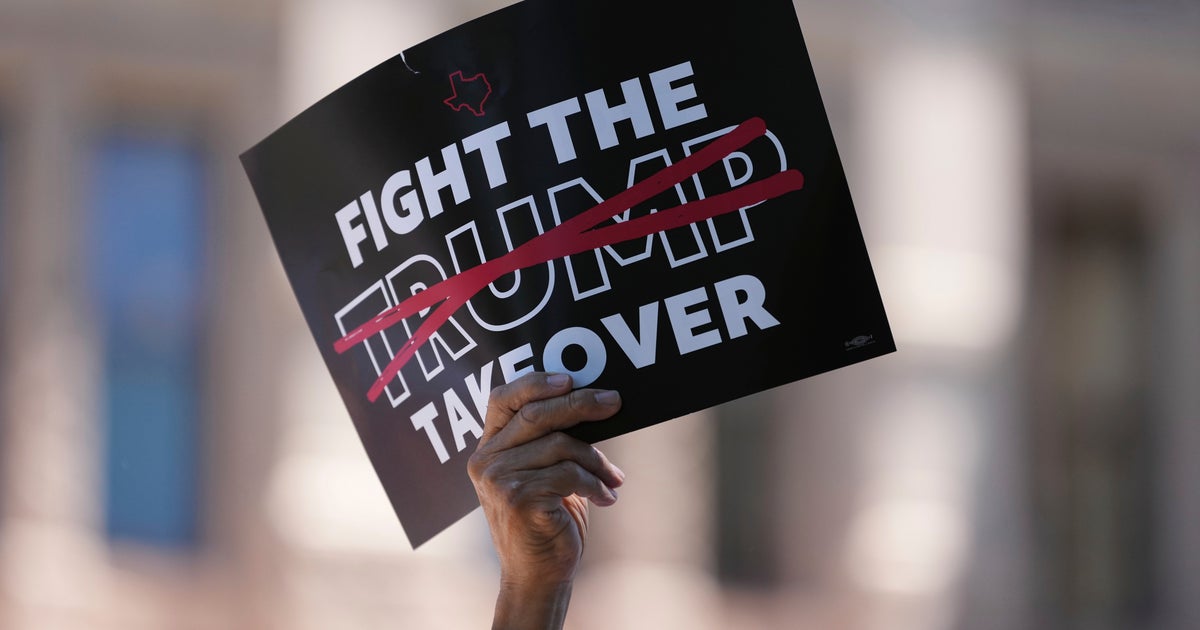
A federal district court ruled that Texas’ mid-decade redistricting enacted in August is an illegal racial gerrymander and ordered the state to use its 2021 maps for the 2026 election.
The decision is a massive blow to President Donald Trump’s effort to pressure GOP states to gerrymander House districts to cushion Republicans ahead of the midterms. The map adopted by the Texas legislature in August would have shifted five seats currently held by Democrats into the GOP column.
Now, it is all up in the air.
Texas’ gerrymander launched a redistricting war unlike any ever seen before. Facing falling approval numbers and the prospect of losing the House, Trump embarked on a campaign to fix the 2026 election by reducing the number of seats Democrats could win by pressuring GOP-run states to redraw their maps. Texas went first, but this was quickly countered when California Gov. Gavin Newsom, a Democrat, responded by initiating a successful process to redraw his state’s maps to offset Texas’ gerrymander.
With the Texas candidate filing deadline quickly approaching on Dec. 8, it now seems questionable whether an appeal from the state’s Republican leadership could come in time to save the map Trump so desperately wants.
An issue in the Texas case is whether Republicans redrew the maps solely based on partisan considerations, which the Supreme Court ruled cannot be judged in the federal courts, or if race played a role. Six plaintiffs brought suit challenging the maps as racially discriminatory under the Voting Rights Act and the Fifteenth Amendment. They argued that the maps, which targeted only non-majority white districts, diluted the votes of Blacks and Latinos by cracking and packing them into other districts.
“The public perception of this case is that it’s about politics,” Judge Jeffrey Brown, a Trump appointee, wrote in his decision, which was joined by Judge David Guaderrama, an Obama appointee. “To be sure, politics played a role in drawing the 2025 Map. But it was much more than just politics.”
The impetus for Texas’ new maps was a letter from Harmeet Dhillon, the assistant attorney general for the Civil Rights Division at the Department of Justice, that argued, erroneously, that the state’s “coalition” districts ― those with majority-minority populations where that majority consists of more than one minority group ― were unconstitutional following a decision by the Fifth Circuit Court of Appeals in Petteway v. Galveston County.
“Any mention of majority White Democrat districts—which DOJ presumably would have also targeted if its aims were partisan rather than racial—was conspicuously absent,” Brown wrote.
Redistricting was added to the special legislative session called by Gov. Greg Abbott, a Republican, two days after Dhillon sent her letter.
“In other words, the Governor explicitly directed the Legislature to redistrict based on race,” Brown wrote. “In press appearances, the Governor plainly and expressly disavowed any partisan objective and instead repeatedly stated that his goal was to eliminate coalition districts and create new majority-Hispanic districts.”
Brown’s decision eviscerates Dhillon’s letter as containing “so many factual, legal, and typographical errors” that it is “challenging to unpack.” The main problem is that the letter completely misinterprets the Petteway decision by arguing that its finding that the Voting Rights Act cannot require the drawing of coalition districts means that coalition districts are therefore unconstitutional.
“Petteway’s ‘holding that [Section 2 of the Voting Rights Act] does not require [coalition] districts’ has no bearing on ‘the permissibility of such districts as a matter of legislative choice or discretion,’” Brown wrote, quoting from other legal precedents.
Brown goes on to point out that Dhillon’s explanations for which districts were unconstitutional coalition districts included multiple factual inaccuracies, including the background about how the district lines were initially drawn. He also notes what is missing from her letter.
“The DOJ Letter is equally notable for what it doesn’t include: any mention of partisanship,” Brown wrote. “Had the Trump Administration sent Texas a letter urging the State to redraw its congressional map to improve the performance of Republican candidates, the Plaintiff Groups would then face a much greater burden to show that race—rather than partisanship—was the driving force behind the 2025 Map. But nothing in the DOJ Letter is couched in terms of partisan politics. The letter instead commands Texas to change four districts for one reason and one reason alone: the racial demographics of the voters who live there.”
The decision goes on to detail how state GOP leaders, including Abbott, premised their redistricting effort on the Dhillon letter and did not say they were pursuing new maps solely for partisan purposes.
Abbott declared that Texas will appeal the ruling to the Supreme Court on Tuesday.
“The Legislature redrew our congressional maps to better reflect Texans’ conservative voting preferences ― and for no other reason,” Abbott said in a statement.
The state will likely argue that the decision was wrong and that it also violates the Purcell principle by initiating an election change too close to the set election dates.
If the decision stands, however, Democratic members of Congress who had announced they would run in new districts or retire are likely to run for the districts they already hold.
“If this decision stands, I look forward to running for reelection in my current district,” Rep. Greg Casar (D-Texas) said in a statement.
Rep. Lloyd Doggett (D-Texas), who planned to retire instead of challenge Casar in a primary for a newly-drawn seat based around Austin, declared that “reports of my death, politically, are greatly exaggerated.” Adding that the decision gives him “a renewed opportunity to continue serving the only town I have ever called home.”