


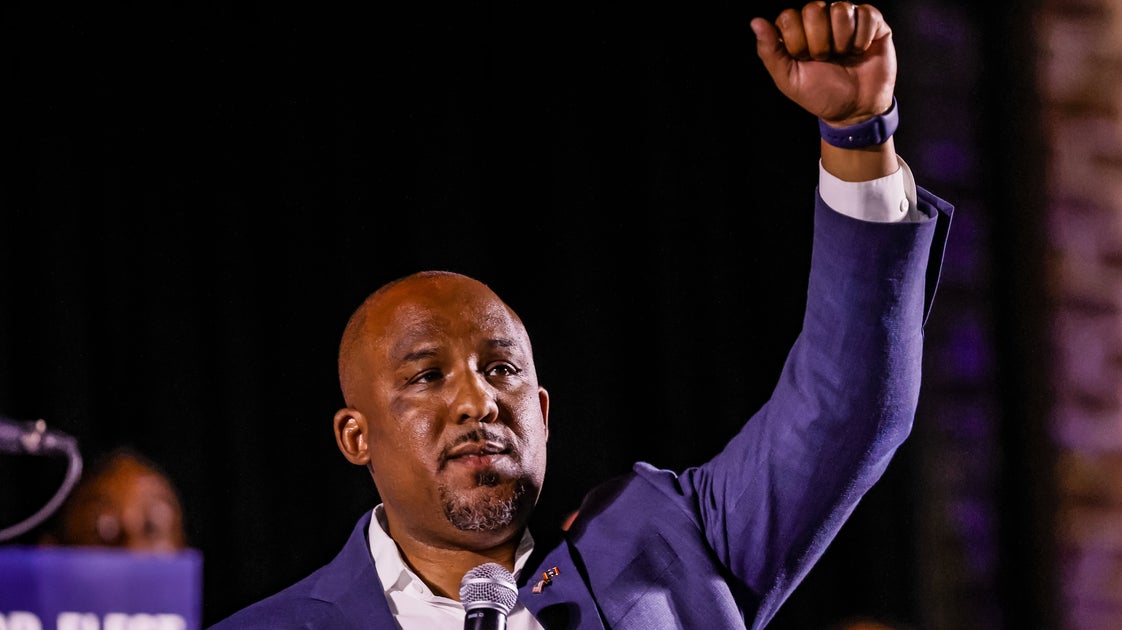
In October 2020, I tweeted about how I’d spent 12 years studying Mississippi election results and telling people the state could become blue or at least purple. People looked at me sideways. Some probably still do. But Democrat Scott Colom’s victory over Republican incumbent Cindy Hyde-Smith, making him Mississippi’s first Black U.S. senator since Reconstruction and the third Black senator in the state’s history, did not surprise me the way it surprised others.
In a recent interview, a reporter asked Hyde-Smith what had happened in “such a red state.” I winced. There it was again: the assumption that a Democrat winning statewide is almost unfathomable. And it’s part of the problem.
For decades, national coverage has reduced Mississippi to a caricature: deeply racist, overwhelmingly conservative and virtually impossible for Democrats to win. Its history of slavery, Jim Crow, racial terror and voter suppression is undeniable, as are its present struggles with poverty, health disparities and environmental injustice. Those realities deserve scrutiny.
But they are not the whole story. When coverage focuses on the state’s worst headlines while paying less attention to competitive elections and Black political organizing, it can reinforce a sense that political change is impossible. And that perception has consequences.
Yes, Mississippi has voted Republican in every presidential election since 1980; Donald Trump carried it by nearly 23 points in 2024. But presidential elections don’t tell the whole story. Barack Obama received about 43% of Mississippi’s vote in 2008 and nearly 44% in 2012. Mike Espy won more than 420,000 votes against Hyde-Smith in the 2018 Senate runoff and nearly 579,000 in their 2020 rematch.
Democrat Jim Hood lost the 2019 governor’s race by roughly 45,000 votes. Brandon Presley lost in 2023 by fewer than 27,000. In 2025, Democrats flipped two state Senate seats, breaking Republicans’ veto-proof supermajority.
These results don’t erase Republican victories or guarantee future Democratic wins, but hundreds of thousands of Mississippians have consistently supported Democrats, and several statewide races have been far more competitive than the state’s reputation suggests. How many close elections does it take before competitiveness stops being treated as an anomaly? HuffPost’s 2023 reporting on Presley examined his outreach to Black voters and the importance of turnout. Yet national discussion has continued to frame Democratic competitiveness in Mississippi as an astonishing exception.
Mississippi did not suddenly become politically complicated. It built on Black political organizing, voter engagement and earlier campaigns that refused to accept that Mississippi’s future was already decided.
Mississippi’s political identity has never been as simple as the label suggests. I understand where the perceptions come from. The state has been the site of some of the nation’s most notorious racial violence, and its leaders have defended policies that denied Black Americans their rights.
But Mississippi is also statistically the Blackest state in the nation and the birthplace of extraordinary resistance and movement building. Hiram Revels and Blanche K. Bruce were the first two Black men to serve in the U.S. Senate, and both represented Mississippi. That history receives far less attention than its history of oppression.
Consider the deaths of Nolan Wells and Kohen Wiley. Both deserve careful reporting, scrutiny of how their cases were handled and compassion for their families. Yet on social media, tragedies like these can prompt a familiar refrain: “Why do Black people even live in Mississippi?” or “Black folks need to leave.” Those reactions overlook generations of Black Mississippians who have built communities and organized for change.
Reporting injustice is essential. Allowing tragedy to define an entire state is not.
I grew up in Natchez surrounded by Black teachers, professionals, neighbors and community leaders who represented a Mississippi rarely seen in national headlines. That experience informs my work as co-founder of Legacy at Madison, a Black history museum preserving lesser-known achievements of Black Mississippians.
I love Mississippi deeply enough to tell the truth about it. I know its painful history, but also its brilliance, resistance and cultural contributions. Preserving that history is part of telling a fuller story about the place I call home.
My work in communications and civic engagement, including this year’s Respect My Vote! campaign, has taught me that narratives shape what people believe is possible. When Mississippi is portrayed as unwinnable by a particular party, national organizations, donors and campaigns may decide it isn’t worth investing in, failing to give a needed boost to the organizing happening on the ground. That doesn’t mean news coverage alone determines funding decisions. It means the assumptions behind those decisions deserve examination.
In August, Mississippi Today reported that the Democratic Senatorial Campaign Committee left Mississippi out of a $40 million investment initiative across 10 states. In October, HuffPost’s Brittany Shepherd reported on the close Senate race and concerns about national support arriving late. State Rep. Zakiya Summers voiced frustration about the lack of earlier investment.
I’d been making a similar argument for years. In 2020, I pointed to Stacey Abrams’ organizing in Georgia as an example of the year-round effort Mississippi needed. In 2022, I argued again for sustained organizing and resources, not just attention during election season.
So my question for my fellow journalists is: Has the repeated framing of Mississippi as “such a red state” helped discourage the political investment that could make its elections more competitive?
Colom’s campaign was not built from scratch. Mississippi Today reported that Espy provided donor and voter lists and advised Colom after his own Senate campaigns. Voter information, relationships and institutional memory are political infrastructure, passed from one campaign to the next.
That infrastructure was tested after Nov. 3. While the count continued, social media filled with jokes about Mississippi being slow and uneducated, allowing the same tired stereotypes to resurface. The irony was hard to miss. As voters challenged the state’s political reputation in real time, the counting process became another reason to ridicule it. Counting every eligible vote is not incompetence. It is democracy. And it underscores that every vote and every election matters, especially in Mississippi.
The count also exposed barriers. A Nov. 6 Mississippi Today investigation reported that eligible voters had been mistakenly marked inactive using unverified Experian address data, despite warnings from civil rights groups. More than 230,000 registrations were reportedly inactive statewide, though not all were erroneous. Secretary of State Michael Watson defended affidavit-ballot procedures, but the reporting raised serious questions about access.
Mississippi’s limited early voting options also complicate participation for people balancing work, transportation, caregiving and health restrictions. It’s a form of voter suppression, and voter suppression is not voter apathy. Given the state’s history of disenfranchisement, journalists should examine its lack of access to the ballot as closely as the results.
Colom’s victory is historic but predictable. Mississippi did not suddenly become politically complicated. It built on Black political organizing, voter engagement, and earlier campaigns that refused to accept that Mississippi’s future was already decided. I have argued that Mississippi is a place where political power is contested, and that no election there should be treated as a guaranteed win for either party.
So the question we all should be asking isn’t how a Democrat won in “such a red state.” It’s why the narrative, for decades, has been a one-sided story while giving far less attention to the organizers, voters and results that tell another.
The numbers were there. The demographic was there. The voters were there.
The story that needed changing wasn’t Mississippi’s.
It was the one America, and the media, kept telling about it.