


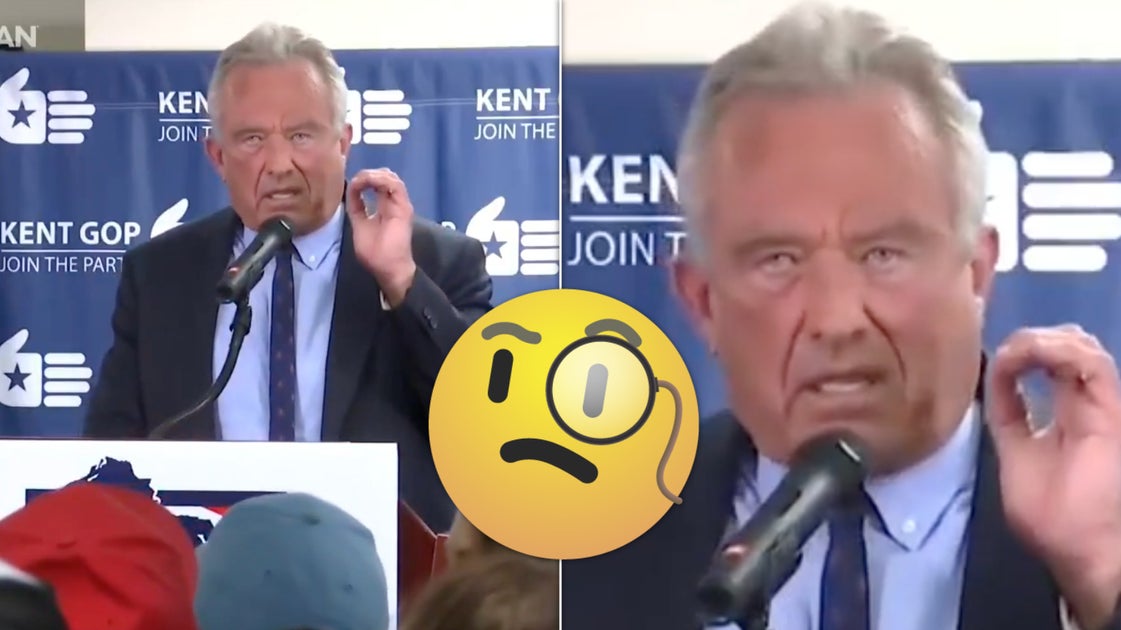
Robert F. Kennedy Jr. tried to land a few low blows to the entire Arab culture on Monday — but he ended up taking a giant swing and a miss.
At a campaign rally in Grand Rapids, Michigan, the Department of Health and Human Services secretary said that Arabs don’t produce science or literature or win major international prizes, claims that historical records contradict. He spoke in support of Senate candidate Mike Rogers and Republican gubernatorial candidate John James.
“Mike Rogers was talking about the Muslim Brotherhood. That’s something I can talk about,” Kennedy said, before claiming that talking about the Muslim Brotherhood “is not Islamophobia,” except he went on to describe followers as a “death cult” with an ideology of “victimization, of murder, of genocide.”
“There’s five hundred million Arabs in the world, and yet they don’t produce science,” Kennedy continued. “They don’t win the Nobel Prize. They don’t win the Fields Prize. They don’t win the Wolf Prize. They don’t produce literature.”
The comments come a week before the midterm elections, when Abdul El-Sayed could be the first Muslim elected to the U.S. Senate.
Kennedy’s claims about the Nobel and Wolf prizes, as well as Arab contributions to science and literature, are inaccurate.
Several Arab individuals and groups have won the Nobel Prize across multiple categories. Since 1978, three have won the Nobel Prize in chemistry: Ahmed Zewail (1999), Moungi Bawendi (2023) and Omar M. Yaghi (2025). Both Zewail and Yaghi also won the Wolf Prize in Chemistry in 1993 and 2018, respectively. Four Arab people have won the Nobel Peace Prize: Anwar Sadat (1978), Yasser Arafat (1994), Mohamed El Baradei (2005) and Tawakkol Karman (2011), along with the Arab group National Dialogue Quartet in 2015. Author Naguib Mahfouz won the Nobel Literature Prize in 1988.
Kennedy’s pivot from the Muslim Brotherhood to the global Arab community does not mean that the two are interchangeable, explains Shadi Hamid, author and political columnist at The Washington Post. While the Brotherhood does have mass support, only a small minority of Arabs are involved in it.
“To treat the Brotherhood as this very powerful organization just simply isn’t accurate,” Hamid said. “It just goes to show that the Trump administration is keen on making the Brotherhood into a boogeyman and using associations with the Brotherhood to vilify American Muslims.”
The Department of Health and Human Services did not respond to HuffPost’s request for comment.

On Kennedy’s claim that talking about the Brotherhood isn’t Islamophobic, Hamid said it depends on how the group is used.
“If you’re using the Muslim Brotherhood as a specter to vilify American Muslims in public life, then I think that is Islamophobia,” Hamid said. “If you’re kind of painting [with] this very broad brush and implying all Arabs are one thing, or all Muslims in the Arab world are one thing, then that’s Islamophobia. You’re not making distinctions.”
To be Arab is an ethnic and linguistic identity, while Muslim is a religion. Detroit has large Christian Arab communities, said Khaled Beydoun, an Arizona State University law professor who lives in metro Detroit.
Beydoun, who is Muslim, told HuffPost that Kennedy’s association between Arabs and the Brotherhood is “just completely ignorant.”
What is the Muslim Brotherhood?
“Oftentimes, when people talk about the Brotherhood, they’re referring to the Egyptian Brotherhood, specifically since it’s the original Brotherhood founded in 1928,” Hamid told HuffPost. There are other branches that have formed throughout more than 70 countries, but each affiliate is independent, Hamid said.
“The Egyptian Brotherhood renounced violence in the 1970s and hasn’t been involved in terrorism, hasn’t really been involved in political violence,” Hamid continued. “Despite that, the Trump administration has designated the Egyptian Brotherhood as a terrorist organization.”
In January, the State Department designated the Lebanese Muslim Brotherhood chapter as a Foreign Terrorist Organization, while the Treasury designated the Egyptian and Jordanian chapters as Specially Designated Global Terrorists for allegedly supporting Hamas. The Egyptian branch rejected the designation.
“The Egyptian Muslim Brotherhood is a peaceful civic and social movement committed to reform through lawful and democratic means,” the group said in response to the State Department’s designation. “We have long rejected violence in all its forms and have consistently affirmed that political and social change must be pursued peacefully.”
The Brotherhood is not a formal organization either, “like the ACLU or the YMCA,” according to Beydoun, adding that anyone with basic knowledge of the region knows there are serious distinctions between the different branches.
“In terms of what [the Trump administration is] doing, is they’re trying to capitalize on the ignorance of the broader public … conflating the Muslim Brotherhood with terrorism,” Beydoun continued. “Capitalizing on the conflation between these groups in order to fearmonger and scare the public.”
Why is the Muslim Brotherhood involved in the Michigan Senate race?
At the candidates’ Oct. 21 debate, Rogers alleged that El-Sayed had connections to the Brotherhood. Rogers said in an Oct. 25 interview with NBC’s “Meet the Press” that he never called El-Sayed a terrorist, but does accuse him of aligning with the Brotherhood.
Rogers has spoken about the Brotherhood before. He was confronted on “Meet the Press” with his remarks from 2012, when he told Reuters that some moderate Brotherhood individuals might need to be engaged, but that the U.S. would have to “watch it carefully.”
El-Sayed has repeatedly denied the allegations and said earlier this month he disavowed the Muslim Brotherhood.
Republican critics have pointed to resurfaced 2012 social media posts by El-Sayed’s half-sister, Eman Abdelhadi, that said their mother, Fatten Elkomy, was once involved with the organization while she still lived in Egypt in the early 1970s, The Hill reported. El-Sayed, who was born in 1984, was raised outside of Detroit by his father, Mohamed El-Sayed, and his stepmother, Jacqueline Johnson, since he was 3 years old.
CNN reported that El-Sayed signed an open letter in 2012 supporting then-Egyptian President Mohamed Morsi, who was elected with Brotherhood support. El-Sayed also published an essay for HuffPost in January 2011 that urged U.S. to support protesters in Egypt and downplayed concerns that it could lead to Muslim Brotherhood control.
However, Hamid argued El-Sayed’s politics are clearly at odds with the group’s ideology.
“Abdul’s politics show very clearly that he doesn’t share the Brotherhood’s ideology,” Hamid said. “He’s a vocal proponent of LGBTQ rights. He hasn’t even opposed trans athletes participating in women’s sports, which is obviously kind of a cultural flashpoint. He has basic socially progressive positions on these kinds of moral questions.”
“One of the most damaging gender tropes against Arab and Muslim men is for them to be super misogynistic and sexist and violent and tyrannical. That is what the Republican Party is running with right now,” Beydoun said. But it’s not necessarily working. “I think a lot of voters who felt alienated and estranged have definitely been galvanized by Abdul and reinserted into the Democratic Party fold.”
HuffPost reached out to El-Sayed, Rogers and James’ campaigns for comment, but did not hear back as of publication.