


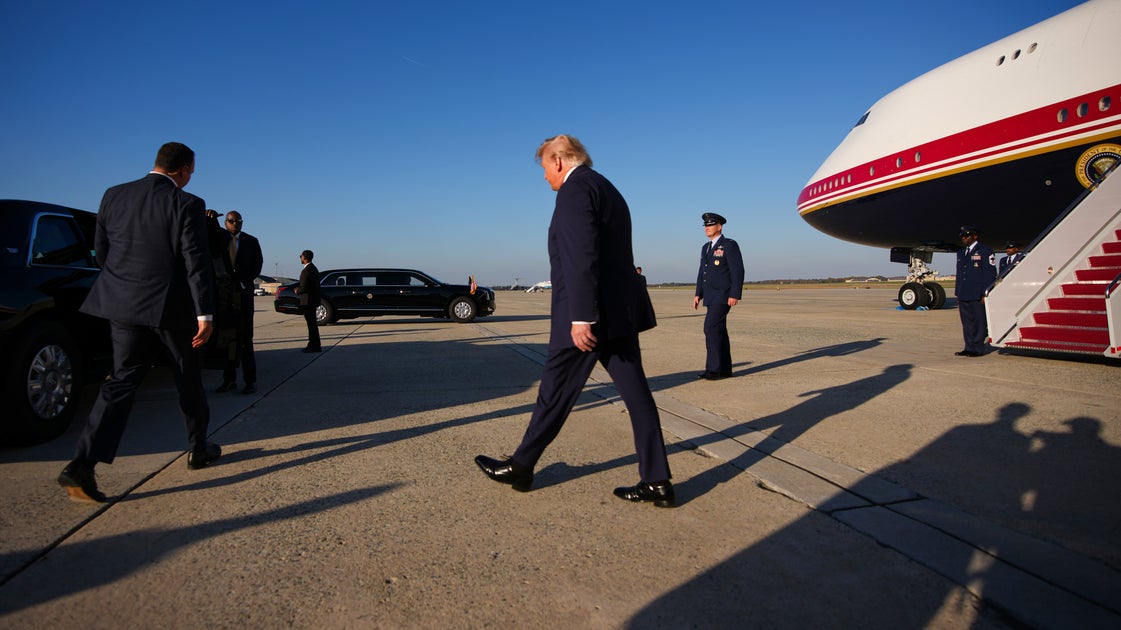
President Donald Trump’s announcement Thursday that he would stay home at his Florida club rather than travel to campaign in Kansas and Iowa this weekend seemed to be a fitting coda to a GOP midterms strategy built almost entirely on using the president to turn out Republican voters who otherwise would have stayed home.
“It didn’t work,” one Republican strategist involved in multiple battleground races wrote in a text message not long after the White House officially canceled the Iowa rally, requesting anonymity to speak frankly about the notoriously volatile president. “And every single congressional Republican is paying the price.”
Trump’s reversal on Friday morning, when the White House said he would instead campaign in both states on Sunday, does not change the assessment. Strategists in both parties believe there is almost no chance for a dramatic turnaround in the GOP’s fortunes before Election Day barring a major polling error, leaving both parties spending millions in a quest for even minuscule advantages in the final days of what has become the most expensive election cycle in American history.

Democrats are pouring money into seats that should be reliably red: Senate Majority PAC, controlled by allies of Senate Minority Leader Chuck Schumer, is spending $750,000 on ads attacking Sen. Darline Graham in South Carolina, and House Democrats are now spending cash in an effort to oust Rep. Richard Hudson (R-N.C.), the chair of the National Republican Congressional Committee.
The Democratic incursion into red territory means both parties are now mostly battling over voters with conservative viewpoints who nonetheless have come to loathe Trump and his administration. Democrats aim to convince as many of them as possible to vote Democrat, while Republicans hope increasingly dire warnings about the damage the opposition could do will motivate their voters to get off the couch.
“The conversion rate of voters who disapprove of Trump into voters who will vote for a Democrat is what will tell us how strong the wave is,” said Jesse Ferguson, a high-level party strategist.
Every voter who disapproves of Trump’s job performance — about three-fifths of registered voters, and even more among those likely to show up at the polls— is a potential vote for Democrats. Right now, public surveys and the party’s own internal surveys indicate that 82% to 84% of voters who disapprove of the president plan to vote for the party’s candidates.
That’s a smaller chunk than in the 2018 midterms, when roughly 90% of those who disapproved of Trump backed Democrats. Why the gap? One major reason is that the additional Trump disapprovers in 2026 are a more conservative bunch, and thus harder for Democrats to win over.
“The closer the number gets to 90 with individual, standout candidates like [Texas Senate candidate James] Talarico, the more likely it is that they’re going to be able to win,” Ferguson said.
The quest to win over these Republican-leaning voters has led Democrats to adopt, at times, messaging with distinctively conservative frames. Government That Works PAC, a Democratic group, has been running ads attacking Sen. Cindy Hyde-Smith (R-Miss.) for not being a “true conservative” and calling her “what Nancy Pelosi would look like if she was from Mississippi.” Another ad resembles a message from the Chinese government and thanks her for putting “China first, Mississippi last.”
Hyde-Smith, who represents a state Trump won by more than 22 percentage points two years ago, finds herself in a tight race with Democrat Scott Colom, a local prosecutor. Republicans and Democrats have poured millions more into the race in the past week, showing that nearly all of the tightest races are now firmly in Trump-won areas.
Other Democrats are emphasizing their willingness to break with their party: State Rep. Josh Turek, the party’s Senate nominee in Iowa, released an ad earlier this week emphasizing his opposition to transgender women participating in high school sports.
“As a Paralympian, I also know it’s important to have rules. It’s why I oppose males competing in female sports,” Turek, who won two gold medals in wheelchair basketball, says in the 30-second ad.
Democrats need to win four Senate seats to take the chamber. Flipping North Carolina’s seat is seen as a lock, and the party is cautiously optimistic about their chances in Texas, Alaska, Maine and Ohio. Victories in Kansas, Iowa, South Carolina or Mississippi, or an independent win in Nebraska, would simply be icing on the cake. But polling in all of these states remains close, Democrats caution, and all are effectively enemy territory for the party.
On the House level, Democrats feel taking the chamber is nearly a fait accompli and are pushing into deep red territory. House Majority PAC, controlled by allies of House Minority Leader Hakeem Jeffries, announced Wednesday it would air ads in three Florida districts, a rural Nebraska seat, and the seat held by retiring Rep. Elise Stefanik (R-N.Y.) in upstate New York. Trump won all five by at least 10 percentage points, and the New York seat by more than 20.
House Minority Whip Katherine Clark, campaigning in a Pennsylvania swing district, told Punchbowl News she expected Democrats to win close to 230 House seats.
“I think we’re looking at a majority of 10 to 15 [seats], but it could so easily be a lot more. The polls are all looking great,” she said.
Republicans had hoped to counteract the typical midterm backlash to the party in power with a Trump-centric campaign aimed at bringing out low-propensity Republicans to minimize the damage. But party operatives closely watching the early vote data have found relatively little to be optimistic about.
“Republicans need to understand if they don’t vote, a lot of very liberal candidates are going to win,” said one GOP operative working on multiple competitive races, requesting anonymity to speak frankly. “Our folks are asleep at the wheel, and we need to highlight the real downsides of Democrat control of Washington.”
Brent Buchanan, the president of the Republican polling firm Cygnal, noted in a social media post that the party’s problems are with the elements of the GOP less enamored of Trump. He noted 81% of progressive Democrats are “extremely motivated” to vote in his firm’s surveys, compared to 58% of traditional Republicans.
“Any path to holding the Senate runs directly through their turnout gap, and that’s the GOP challenge to solve this final week,” he said.
Trump’s canceled rallies are being replaced by more than 20 tele-rallies for candidates around the country, the Republican National Committee said, claiming the rallies in Kansas and Iowa were canceled because candidates in those states are in strong positions.
Meanwhile, Democrats are feeling optimistic about a key group of voters they have struggled to turn out in recent midterms. Early voting data in Louisiana, Georgia and North Carolina has the party optimistic about Black voter turnout, with backlash to the Supreme Court’s decision gutting the Voting Rights Act playing a key role in firing up southern voters. Their anger is making Democrats more optimistic that Rep. Shomari Figures (D-Ala.) could hold his seat in a district the GOP redrew to be safely Republican. The NRCC began spending in the district on Thursday.
Terrance Woodbury, the president of the Democratic polling firm HIT Strategies, said Black voters’ willingness to participate in “resistance” activities like protesting spiked following the Callais decision, as did their view of how much their vote matters, reaching a level not seen since the aftermath of the George Floyd killing in the summer of 2020.
“Black voters are motivated to protect their rights and to prevent further harm from Republicans,” he told reporters in a Tuesday conference call presenting research from the Black Opps Project, adding: “We expect this Blacklash to continue to carry and drive a lot of the political participation that we see until Election Day.”
Both parties have also begun quiet efforts to boost third-party candidates in hopes of drawing votes away from major-party candidates. The most prominent effort so far is a multimillion-dollar, Republican-backed effort in Ohio to boost Greg Levy, a socialist on the ballot there, to draw votes away from former Sen. Sherrod Brown, the Democratic nominee. Operatives in both parties are also keeping a close eye on the vote share of Thomas Laehn, a Libertarian on the ballot in Iowa who has drawn more than 5% of the vote in some recent surveys.