


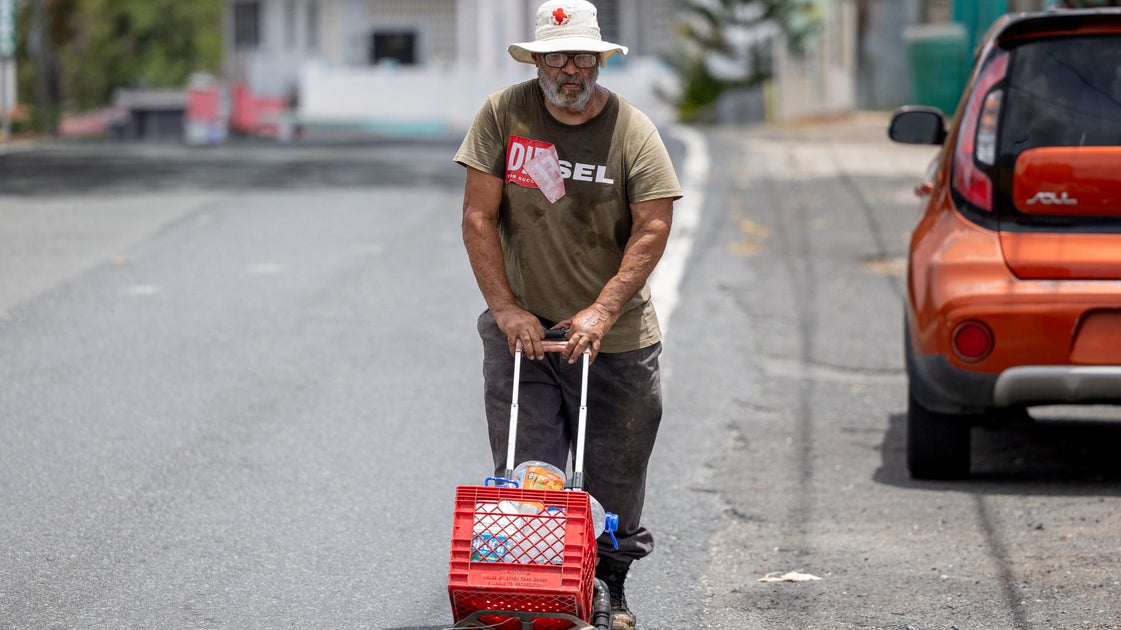
For a full year, long before Puerto Rico’s current drought led the government to begin rationing water, Luz “Lucy” Rivera has learned to live “a cubito,” collecting and storing water one bucket at a time.
When she opens her faucet during the scheduled 48-hour service window, she knows not to expect much. The water arrives unreliably, often as little more than a thin trickle, too weak to shower, wash dishes or do laundry. Instead, she depends on water delivered by municipal tanker trucks.
Rivera, now 71, has spent her entire life in Playita, a community in San Juan’s Villa Palmeras sector. Despite living with osteoarthritis, fibromyalgia and diabetic neuropathy, she’s become a community leader amidst the island’s most recent water emergency. When a tanker reaches her neighborhood, she’s the one making sure older neighbors who cannot carry water themselves receive it.

“Your energy runs out. Your spirit runs out,” Rivera tells me. “For us older people, this is an uphill battle.”
Under the government’s new plan, residents are supposed to have water for 48 hours, followed by 48 hours without it. But to Rivera, the idea of rationing water that was never reliably reaching her home makes little sense.
Across metropolitan San Juan, Puerto Rico’s water crisis transformed our most basic utility into a highly sought-after luxury. More than 180,000 customer accounts supplied by the shrinking Carraízo, one of the reservoirs serving the area, were placed on alternating 48-hour shutoffs in August. Those accounts include homes and businesses across San Juan and six neighboring municipalities.
But for Rivera and two other older San Juan residents interviewed for this story, the official drought explains only part of what they are living through. All three said their service had become unreliable about a year before formal rationing began. The drought did not create their daily uncertainty, they said. It deepened it.
At the highest point of Santurce, Marta Acevedo, 75, can see far beyond her condominium. The elevation is beautiful for the view and punishing for water pressure. She has lived there for 44 years with her partner. More than 60% of the owners in her 118-unit building are over 65, and running water has reached the building in only 90 days this year, she tells me.
Her building has two cisterns with a combined capacity of nearly 50,000 gallons. That sounds enormous until it must serve more than a hundred apartments, including large households, people managing cancer or lupus, and residents who are physically disabled — some of whom rely on breathing equipment.
When tanker trucks do not arrive on time, the condominium imposes its own rationing. During the most restrictive periods, residents have received water intermittently for no more than three hours a day.
“People are fed up because they see no light at the end of the tunnel. We’re tired. There is no quality of life,” Acevedo says. “And on top of that, there are the constant power outages.”
Acevedo is quick to say that she is among the more protected residents: Five years ago, the condominium’s residents purchased a large generator. In neighboring buildings, a full cistern can become useless during a blackout because the electric water pump does not work.
Those protections are expensive and not accessible to all. A cistern, a generator, solar panels, restaurant dinners and bottled water divide residents between those who can afford to purchase a sense of normalcy and those who are forced to wait for help.
The result is not only inconvenience. It is a life scheduled around basic necessities. An invitation to go see a movie, Acevedo says, first requires a question: What time is the show? A morning to sleep late may mean missing the window to shower. Even her trips to the gym depend on whether water will be available.
She and her partner eat out more often to avoid cooking and washing dishes, though that solution sometimes fails when nearby restaurants are also without water. Cafe Regina, for example, has been documenting each day it goes without service, a silent but powerful record of the crisis.
For residents without cisterns, the situation is more precarious. In Ocean Park, 66-year-old Alfredo Cuyar wakes up hopeful on scheduled service days, only to be disappointed again. Born and raised in the community, he now lives there with his wife in a house without a cistern.
“I’m always on edge, anxious,” he said. “You wake up hoping you’re going to have water and be able to do your chores, live a semi-normal life, and you discover you can’t because the water never arrived when it was supposed to.”
Cuyar stores gallon jugs in the kitchen and bathroom until his home begins to resemble a warehouse. At times, he goes to friends’ homes to shower. He said he knows retirees who must now choose among medication, food, and water.
He became a community organizer after Hurricane María and later co-founded the coalition “Exigimos Agua” with Santa Teresita resident Dara Rivera. The group connects residents across the San Juan, Carolina, and Loíza municipalities, sharing service updates and helping neighbors find water. In the absence of reliable official notices, the group chat has become an improvised guide of who has water, who does not and who needs help.

“Many live alone and have no one to help them,” Cuyar says. “The help they are receiving is help from the community itself.”
Puerto Rico is enduring severe dry conditions this year. San Juan recorded its driest July in more than 120 years. On Aug. 26, the U.S. Department of Agriculture issued a drought disaster designation covering 26 municipalities, opening emergency loan programs to eligible farmers and agricultural producers. That agricultural designation is separate from a major-disaster declaration; Gov. Jenniffer González claimed that Puerto Rico had not yet met the threshold for the latter.
The current rotating shutoffs were triggered by falling levels at the Carraízo reservoir. Yet the shortage is magnified by an aging water system marked by leaks, breaks, and maintenance issues.
“The problems began when the current administration made changes at the water authority,” Cuyar believes, going on to describe his dissatisfaction with new officials’ systems for water distribution and operation. “We are the guinea pigs paying the consequences.”
“Exigimos Agua,” the coalition led by Cuyar, is seeking changes to management and called for the removal of the public corporation’s executive president, according to local outlet El Nuevo Día.
All three residents interviewed for this express disappointment with the manual operation of distribution valves for much of the unreliable service. But what may appear to be an infrastructure failure on paper becomes a physical burden for older residents.
For them, every workaround carries a physical cost. Carrying five gallons of water means lifting more than 40 pounds. Collecting it from a tanker can mean standing in Puerto Rico’s heat, while missing a brief service window can mean another day without showering.
The crisis has pushed Cuyar to consider temporarily leaving Ocean Park in search of a more normal life. Rivera, meanwhile, remains focused on neighbors who use canes, have impaired vision or cannot carry water themselves. Without her in the community, they could not manage alone.
“It’s the shamelessness, the failure to follow through and the lack of communication from the authorities,” Rivera says. “Thank God that I can still move.”