


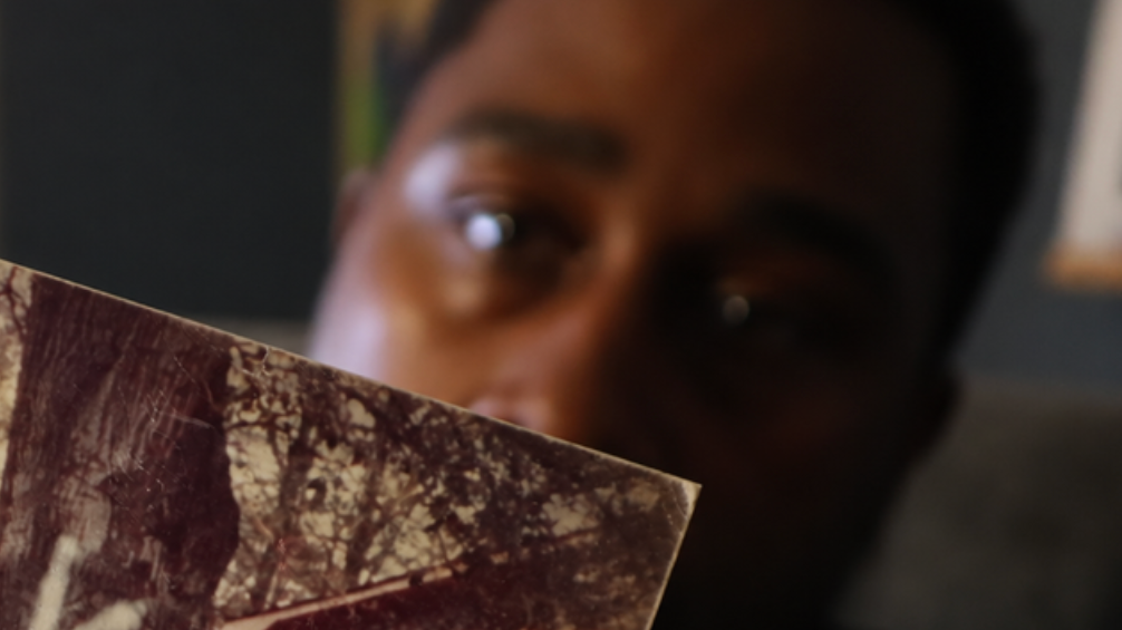
I found the photograph by accident.
It was buried in an old shoebox of loose family photographs, dusty and faintly smelling of mothballs. Most were people I didn’t know, along with the occasional picture of a younger me — versions of my own childhood I recognized without actually remembering.
The picture itself wasn’t remarkable: our little house, the front yard, a huge oak tree stretching over the lawn.
But there was nothing ordinary about what had been painted across the trunk.
Three letters: KKK.

I don’t remember who took the picture. I was young when I found it. I only remember the fear I felt. The photograph made the Ku Klux Klan feel enormous. Not just dangerous — but like it was everywhere.
I knew that was our home. That was our tree. And those letters felt like a mark. They knew where we lived. They could come back.
I didn’t tell my parents what I’d found. We had already moved away from that house by then, and in the simple cause-and-effect logic of a frightened child, I decided those things had to be connected: The Klan found us, and we had left because of them. No one corrected that story because I never gave anyone the chance. I just put the photograph back, but the fear stayed with me.
After that, every new thing I learned about the Klan had somewhere personal to land. Burning crosses, white robes, lynchings, night rides, hooded men carrying torches — each new image added detail to something that, in my mind, had already reached my family.
What happened in history books wasn’t safely contained in the past. It could find us. It could find our house. It already had.
For years, some part of me carried that fear. That is how terror works when it succeeds. It doesn’t have to remain in front of you. It only has to leave behind an image powerful enough to keep doing the work.
It wasn’t until recently that I realized the fear had never left me. So, I began studying the thing I had been taught to fear.
I expected to learn just how powerful and heinous the Klan had been. Instead, I found paperwork. Membership applications. Commission schedules. Robe-order forms. Recruiting quotas. Internal audits. Financial disputes. Among those records was an ordinary-looking Klan membership questionnaire from the 1920s — a form that would completely change how I viewed the organization.
The deeper I dug, the less it resembled an all-powerful secret order and the more it resembled a business.
Every document peeled away another layer of intimidation until I was no longer looking at a giant. I was looking at small men wearing expensive costumes.
That realization didn’t make the Klan less evil. But it made the machinery easier to see.
The terror was real. The mythology was manufactured.
Manufactured did not mean imaginary. The murders, bombings, lynchings, threats and political violence were real. What the Klan was actively manufacturing was the image of an unstoppable racial order reaching into every corner of American life. That image was itself a weapon.
I had to force myself to sit with images that had frightened me since childhood. Every photograph of masked men and every symbol I encountered carried the weight of the violence I already knew those men had committed.
But somehow the paperwork kept changing things for me.

Economists Roland Fryer and Steven Levitt studied surviving records from the second incarnation of the Ku Klux Klan, which was founded in 1915, and found an organization built not only to spread hatred, but to sell it.
Recruiters earned commissions. Members paid initiation fees and dues. Robes and other regalia were sold through approved channels. Organizers received financial incentives for bringing in new members and expanding local chapters. The commission-driven structure had the unmistakable strategy of a pyramid scheme. Money and influence flowed upward while organizers below were responsible for recruiting the next layer.
In America, even hate can be packaged, marketed and monetized.
The organization had learned how to convert loneliness, fear, insecurity and resentment into recruits, customers, foot soldiers and political instruments. Members were paying for more than robes and dues. They were paying for belonging, certainty and the feeling that they stood above someone.
The rank-and-file Klansman did not own the machine. He was another input — dangerous, culpable and useful to the men above him.
Organized racism has always required organization. Somebody prints the pamphlets, collects the dues, sells the uniforms, invents the rituals and decides who the enemy is. Somebody turns resentment into structure.
And somebody profits.
Not every Klansman was poor, and many occupied comfortable positions in their communities. But W. E. B. Du Bois identified a currency that extended beyond income: whiteness offered status to men at nearly every level who were willing to defend the hierarchy above them.
In “Black Reconstruction in America,” Du Bois described the “psychological wage” offered to poor white laborers after slavery. Many remained economically exploited, but they received social preference, public respect, and the reassurance that however difficult their lives became, they would still be treated as superior to Black people.
In this country, the idea of white superiority has long been traded like currency. Its value is conditional, but it spends most reliably when directed downward. It gives its believers no ownership of the system, only permission to defend it.
As I looked through more records, I found something simple and unassuming bearing those three letters — KKK — at the top.
But this time, it was a blank membership form preserved among the papers of W. E. B. Du Bois.
Name. Address. Occupation. Age. Church. Fraternal affiliations.
It doesn’t look like an instrument of terror. It looks like something you might fill out to join a lodge, request an insurance quote or join a Rotary club.
That ordinariness unsettled me more than another photograph of a burning cross would have.
The application’s requirements appear in one dense paragraph. The applicant must be a white, native-born, Protestant Gentile American. He must believe in constitutional government, free public schools, free speech, a free press, separation of church and state, liberty, white supremacy, just laws, the pursuit of happiness, and the sanctity of the home.
Seeing that paragraph brought together something I had felt all my life but had never been able to explain: the uneasy proximity between exaggerated patriotism and racial threat.
In the South, where I grew up, an oversized American flag often felt only a step removed from a Confederate one. I know how unreasonable that might sound to someone who has never felt the warning contained inside the display. But there, in the Klan’s own application, was the connection in plain language.
White supremacy sat between liberty and just laws as though it were simply another civic virtue.
The Klan was not marketing terror as terror. It was packaging racial domination with faith, family, education, patriotism, morality and the Constitution. It offered men a story in which they were not participants in racial violence but guardians of the nation. Their fear became courage. Their resentment became patriotism. Their cruelty became protection.
Then it charged them for the costume.

In 1921, they attached this psychological approach to a commissioned sales force and widened their campaign against Jews, Catholics, immigrants and anyone else who could be cast as a threat. That strategy helped membership rise from roughly 500,000 in 1921 to, according to the hate group, 4,000,000 by 1924, before collapsing almost as quickly.
That was the fact that finally switched the light on for me.
The robes and rituals were elaborate, but the argument underneath them was almost painfully simple: tell people something is being taken from them. Tell them the country they understood is disappearing. Tell them that people who don’t belong here are gaining ground at their expense. That their discomfort isn’t prejudice but proof that they’ve been wronged. That what they need isn’t adaptation, but restoration — a return to an order in which they knew where they stood and, just as importantly, who stood beneath them.
Once I saw the formula, the timeline collapsed. Past became present.
I wasn’t looking at some antiquated system anymore. I could see the thread running out of those old documents and into something even closer to home than that oak tree.
I still think about the person who walked into our yard carrying a spray can. As a child, I imagined them as an extension of something enormous. An order so powerful that it could reach through history books, cross into our neighborhood, and mark our family’s home. Perhaps they even believed they had defended their community, their country or their place in the world.
But when I look at the photograph now, I see something more familiar: someone borrowing power from a hateful movement that made them feel larger than they were alone. A person whose fear and insecurity had been exploited, monetized and sold back to them as belonging and power.
I don’t need the photograph to remind me how real that formula still is. Once you recognize it, you start noticing its variations everywhere.
Still recruiting.
Still converting.
The names and leaders change. The symbols and costumes look different.
But the scam beneath them remains the same.
Michael Martin is a freelance writer based in metro Atlanta who focuses on race and the American experience. He runs Tru Nobility, a brand celebrating Black history and culture through classroom resources, apparel and storytelling. He is the father of three children. Read more of his writing at TruNobility.com.
Do you have a compelling personal story you’d like to see published on HuffPost? Find out what we’re looking for here and send us a pitch at pitch@huffpost.com.