


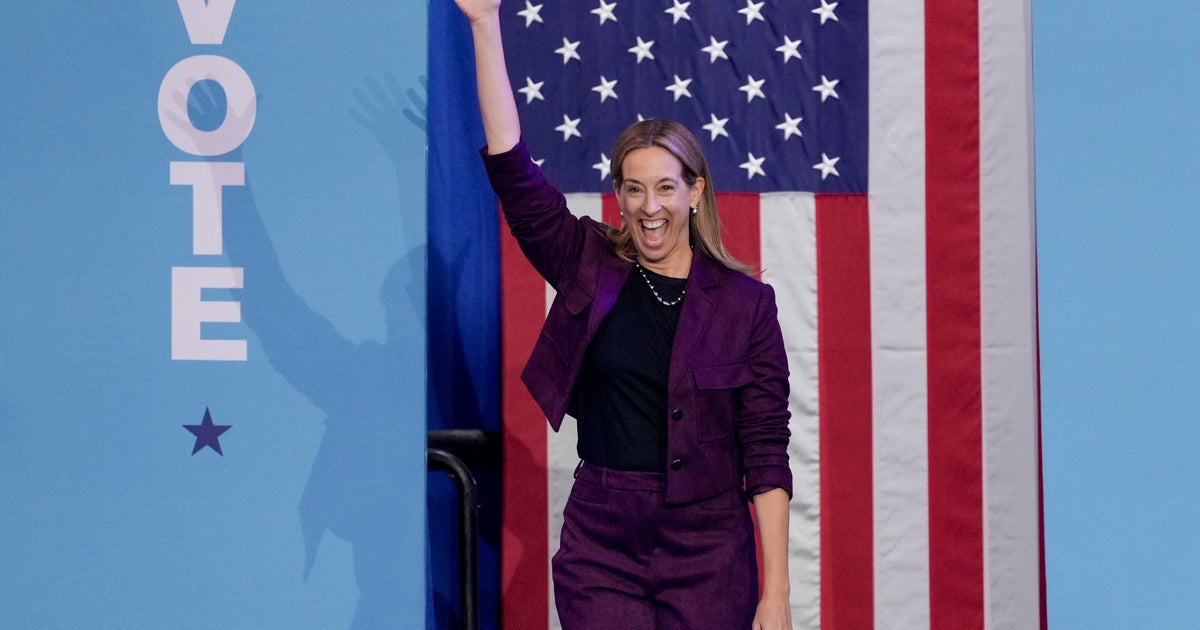
After a closely fought campaign, Democrat Mikie Sherrill is projected to be New Jersey’s next governor.
Sherrill, who’s currently the U.S. representative for the state’s 11th Congressional District, on Tuesday night beat Republican Jack Ciattarelli in the Garden State. Her victory, in a race widely seen as an early referendum on the Republican agenda in Donald Trump’s second presidential term, is a blow for the GOP.
Sherrill quickly celebrated her win on social media, thanking voters in the state. ”I promise to listen, lead with courage, and never forget who I serve,” she wrote on Bluesky.
Just after 10 p.m. ET, as she took the stage for her victory speech, Sherrill held more than a 13-point lead over Ciattarelli.
“They always say we’re loud,” she joked of her state as she began her speech. “But you guys just screamed from the rooftops, and people around the country have heard you.”
“Serving you is worth any tough fight I have to take on, and I am incredibly honored to be your next governor,” she added.
Sherrill had a slight lead over Ciattarelli in polls during the weeks leading up to the election, with many showing her leading him by a margin of only a few percentage points. Early voting also initially hinted at a positive outcome for Sherrill, with early in-person votes from registered Democrats outpacing those of registered Republicans.
In a race that was largely defined by affordability issues, both candidates sought to portray themselves as bringing fresh solutions to the table on issues including energy costs, school funding and property taxes.
On the campaign trail, Sherrill touted her history as a former Navy helicopter pilot and a former federal prosecutor, portraying herself as capable of fighting for the interests of New Jersey residents against the federal government and business interests, like those driving up costs on pharmaceuticals or energy.
But both campaigns were also overhung by the national political landscape.
Though New Jersey is often considered a blue state — registered Democrats outnumber registered Republicans in the state by about 800,000 — Republicans have been on the rise in the state in recent years. To boot, New Jerseyans have been largely dissatisfied with outgoing Gov. Phil Murphy, a Democrat whose approval rating is at a bleak 35%, leaving an apparent opening for Republicans.
But the state also swung against Donald Trump in both the 2020 and the 2024 elections, with Vice President Kamala Harris winning New Jersey by about 6 points in 2024. Things have gotten worse for the president since then: In a national Washington Post/ABC News/Ipsos poll, 59% of U.S. adults said they disapprove of Trump’s handling of the presidency.
Nonetheless, Ciattarelli accepted Donald Trump’s endorsement and, during the final debate of the campaign, said he would give the president an “A” rating. “He’s right about securing the border; inflation is much lower than under Biden; he halted offshore wind; he’s pushing back on New York’s congestion pricing; and he quadrupled the SALT deduction,” he said of Trump.
Sherrill, on the other hand, slammed Ciattarelli’s connection to Trump and positioned herself as an opponent of the president, condemning his landmark legislation, the so-called Big Beautiful Bill. “Trump’s cuts leave a $5 billion hole in [the New Jersey] budget. He’s cut energy support amid a utility crisis, raising family costs by hundreds of dollars; he’s slashed Title I school funding, raising local taxes. I’ll fight that and fight Trenton to lower costs,” she said at the same debate, at which she gave Trump a rating of “F.”
She also promised to fight the president in court over the freezing of funds for the Gateway tunnel project, a long-delayed infrastructure program to add another tunnel beneath the Hudson River to connect New Jersey to New York City.
Tuesday’s elections are the first significant ones since Donald Trump resumed the presidency, and both parties are looking to the contests, including the governor’s race in New Jersey, for signs of whether the political winds are shifting.
As Trump upends democratic norms in the United States and a federal shutdown drags on and on, Democrats have hoped to turn dissatisfaction with the president into momentum for their party and encouragement for resistance. Meanwhile, Republican candidates largely stayed in lockstep with the president, gambling that MAGA support and Trump’s approval will be enough to give them the win.
This year, that gamble went in Sherrill’s favor.