


I knew my 10-day trip to Japan this year would be expensive — exchange rates are great, but that flight is no joke. What I didn’t expect was that my priciest souvenir would be a wicked case of plantar fasciitis. The hours I spent walking through packed city streets and picturesque mountain paths took their toll. (I was in sneakers the whole time, so this just seems unfair.) But I feel much better after stumbling on a solution to my pain that cost $10.

It turns out, my situation was pretty common. About 10% of people at some point develop plantar fasciitis, inflammation and micro-tearing in the fascia on the bottom of your foot, according to StatPearls. It causes foot pain (usually in the heel) that can range from a mild ache after sitting for too long to pain so acute that you don’t want to get out of bed in the morning. Austin-based podiatrist Anne Sharkey, DPM, says middle-aged tourists like me are particularly susceptible.
“When someone comes in with plantar fasciitis, the first question I’m asking is, ‘What changed in your life?’” she says. Common triggers are new shoes, a new workout, a new job, a new baby, or — yep, a vacation where you might be walking more miles on different terrain and also wearing new shoes. An added risk factor for women like me is perimenopause. “Some plantar fasciitis can also be attributable to the decrease in estrogen, the way our collagen changes, and having less shock-absorbing capabilities [in our tissue],” Starkey added.
If you’ve had foot pain, you know why I was ready to throw my very last dollar at this problem as soon as I had a diagnosis. My own podiatrist sold me two pairs of orthotics to support my high, aching arches and gave me a really uncomfortable splint to stretch out my calves at night (after about five minutes, I was done with that forever). I was also using my Theragun, a red-light therapy pad, ice packs, and a wide variety of compression socks, and not seeing any immediate results. Meanwhile, I watched every video on the internet in which physical therapists and podiatrists tried to sell me fancy massaging and stretching machines.
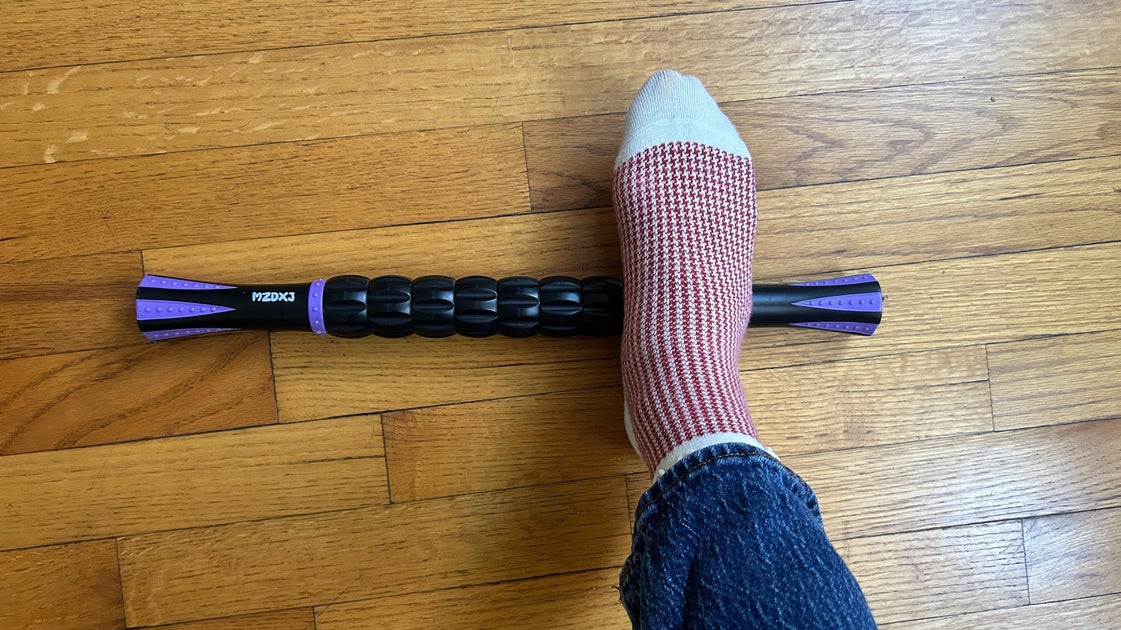
That’s when I literally tripped over the cheap massage stick my husband had purchased for his hamstring injury and left on the floor. The MZDXJ muscle roller is 18 inches long, with nine ridged rollers that move independently of each other and flared ridged handles at both ends. I don’t normally go in for products with brand names that are an unpronounceable random combination of letters, but this seemed like a sign.

I decided to plop it on the floor under my desk and roll my feet on it while I worked all day. I could fit both feet on it at once, and it felt really good to work those ridges into all the parts of my soles that felt stiff. The sharper ridges on the handles were just as helpful as the softer rolling ones in the middle of the stick. As a writer, I spend a lot of time at my desk, which meant I was running my feet over this thing for hours every day. And over the course of a few weeks, my pain started to lessen.
Sharkey confirmed that I was not just imagining that the roller was doing something. By pressing my feet hard onto the stick, I was unconsciously mimicking the Graston technique, a type of deep massage with tools performed by physical therapists. A scientific review published in the “Journal of Therapeutic Massage and Body Work” this year showed that Graston technique and “deep friction massage” are effective treatments for plantar fasciitis.
“By causing a slight tissue injury in that area, you’re [signaling] the body, ‘Hey, there’s an injury here. Let’s get this anti-inflammatory and healing process started,’” Sharkey explained. “You may have been breaking up any scar tissue that was forming. You may have been encouraging blood flow to that area. And as there’s more blood flow, it’s going to help mobilize the lymphatic system and flush the painful area.”
While the MZDXJ muscle roller isn’t advertised as a tool for plantar fasciitis relief, other customers have also discovered how well it works for this.
“I have plantar fasciitis on one foot, and this thing is perfect for massaging under the arch and stretching the tendon,” wrote W. Cass on Amazon. “I talked my sister into getting one too after she tried it.”
Meanwhile, there are hundreds of five-star reviews praising its use on the rest of the body. “Nothing complicated here, but this thing works,” Mike O. said. “I use it mainly on my legs, calves, and back after I’ve been sore, and you can put as much or as little pressure on it as you want. What I like is that it’s firm enough to actually dig into tight muscles instead of just rolling over them. The length also gives you enough leverage to control the pressure without killing your hands.”
The fact that my pain is gone doesn’t mean I’m cured for good, Sharkey says, but the inflammation is gone. I’ll still need to make sure my shoes are supportive and that I stretch my calves regularly to prevent a recurrence. At least I know that if my next vacation does this to me again, I’ve got my treatment plan and trusty massage stick at the ready.