


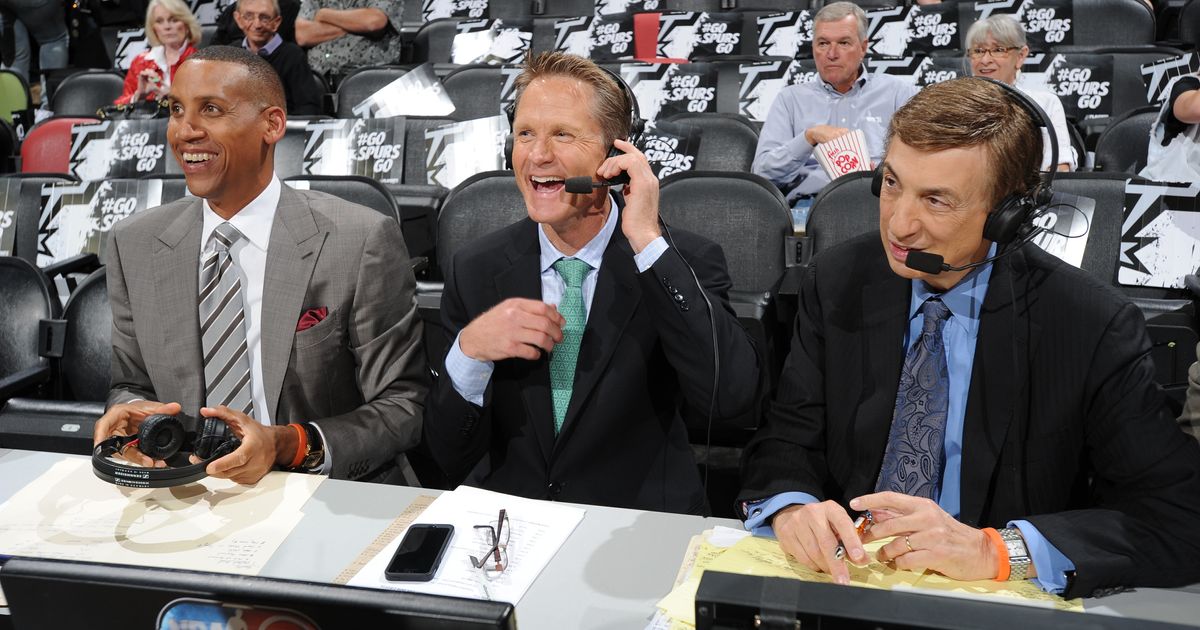
Marv Albert is often referred to as “the voice of basketball.” An eight-time Emmy Award winner and a National Sports Media Association Hall of Fame inductee, the 75-year-old broadcaster has been calling NBA games since 1967.
Throughout his illustrious career, Albert has also broadcasted six Super Bowls, two World Series, the NBA Finals and the Stanley Cup Finals, among other marquee events.
The TNT announcer, who will call his 22nd NBA All-Star game this weekend in New Orleans, told The Huffington Post about his relationship with Golden State Warriors coach Steve Kerr, explained why the New York Knicks are a disaster and described how social media has changed the NBA’s overall landscape.
This interview has been edited and condensed for clarity.

You covered the Olympics in Rio. Team USA had a stretch where it wasn’t dominant and actually struggled a bit, before ultimately capturing a third straight gold medal. Did you ever get the sense that coach Mike Krzyzewski was worried?
I think that Coach K was very concerned, actually. Carmelo [Anthony] didn’t look like he was in the greatest shape, and also his shoulder was bothering him. The only good game he had ― we talk about it constantly ― was against China, where you and I might have put up double figures.
Until they finally changed the rotation and went with [Kyle] Lowry and [Jimmy] Butler ... that’s when they started to roll. Even though [DeMarcus] Cousins overpowered people, it was better to have DeAndre Jordan in there. He had to figure it out.

You’ve covered George Karl throughout your career. He just published a book that was very critical of Cousins, as well as many other players he coached.
We always spent about 10-15 minutes before games with the coaches and you couldn’t leave, he didn’t want us to leave ― he just wanted to talk.
Phil Jackson did that too, while he was still coaching the Lakers. He’d take shots at Kobe in his books. He couldn’t reach Shaq, and Kobe [Bryant] too, which is tough. He would take shots in the papers ― in Chicago he did it a little bit. He was a little more careful because Michael [Jordan] was not going to accept that. The only people he would take an occasional shot at was like [Toni] Kukoc, who was a great guy and really a very good player but he was like the whipping boy. He always had a guy he would be screaming at, Horace Grant and Kukoc.
Do you enjoy the current NBA product, considering there is such an assortment of one-and-done college players?
The fundamentals are not, at times, what they were when guys were playing three or four years [in college]. A guy like C.J. McCollum, who comes in from Lehigh and turns out to be a tremendous player ― but I mean, he’s gifted ― that doesn’t happen that often. Usually, if the guy is really that good, they wanna come out, and I can understand it. You don’t want to get hurt, you could blow a contract, obviously you get the higher salary quicker.
But the league is in the best shape it’s ever been in terms of marketing, the global aspect, and I realize there’s always an argument ― are you better off with parity, or having the super teams? And right now, you basically have two teams ― maybe three in the West ― who maybe have a shot? I don’t know if that’s even true ― it’s probably Golden State and San Antonio. And in the East, although Boston is getting better, they’re like a player away from something.

When did it really hit home for you that this league is, at its core, a business?
I think more so in the ‘90s. Teams when I first started ― you did have nucleuses of teams staying together, of the better teams. In the ‘70s, the Knicks, the Celtics, Milwaukee, you had teams with seven or eight guys that would be there for several years.
Young players are pushing older players out because they are often cheaper, even if they aren’t as good.
Except if they have contracts, those players pushed out would be the eighth player on the roster.
Do you remember such an influx of talented point guards?
You always have to go back and look. Sometimes it seems like the present, but you’re probably right. I’m thinking just like a broad view in my mind of the ‘90s. It was different ― it was more plodding.
It’s funny, I’m doing stuff on [Russell] Westbrook. He’s chasing Oscar [Robertson] for the triple-double. It didn’t seem like it when I think back to it, but Oscar ― when he did it in ‘62 ― they played at a faster pace. They had like 120 possessions a game and Oklahoma City has 105 or something, it didn’t seem like it.