


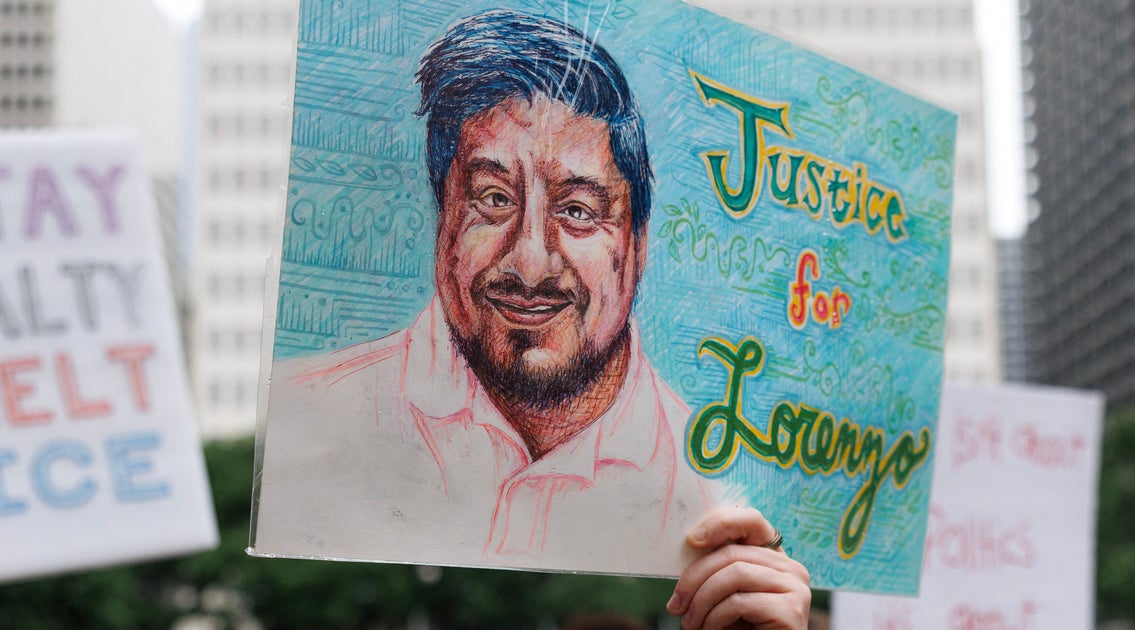
A federal agent who shot Houston man Lorenzo Salgado Araujo earlier this month switched guns with another officer after firing, one witness in the case said in a recent court filing.
Salgado Araujo, a father of three, was pronounced dead after the encounter with federal immigration officials.
“After they took Lorenzo, another agent came and switched guns with the agent that fired the shot at Lorenzo,” wrote Daniel Tirado Pantoja, who was a passenger in Salgado Araujo’s work van at the time of the shooting.
Houston CBS affiliate KHOU first reported the witness statement, which was included in a federal court filing, and was followed by the Texas Tribune, Houston Chronicle, Click2Houston, and others.
Gonzalez Olivieri LLC, whose chairman Raed Gonzalez represents Tirado Pantoja and another witness, Jose Trinidad Rojas Pliego, provided the statements directly to HuffPost on Thursday, typed in both Spanish and English. (We are quoting the English translations in this story.)
It’s unclear why agents might switch guns after a deadly shooting, or whether doing so after a shooting may be a common practice for federal agents — for example, to collect the fired weapon as evidence.
A Department of Homeland Security spokesperson referred HuffPost to the department’s Office of Inspector General for questions regarding “an investigation into the agent-involved shooting,” and FBI Houston for questions regarding “an investigation into the potential assault on a federal law enforcement officer.”
A spokesperson for the FBI’s Houston office wrote in an email: “The FBI does not comment on open investigations.” The DHS inspector general’s office did not immediately reply to a request for comment.
On July 7, two unmarked vehicles belonging to U.S. Immigration and Customs Enforcement followed a van carrying four men, including Salgado Araujo, who was driving. One ICE agent shot Salgado Araujo, which DHS claimed was done in “self-defense,” alleging Salgado Araujo had “rammed an ICE law enforcement vehicle” and “weaponized his vehicle in an attempt to run over an ICE law enforcement officer.” DHS has a history of lying about similar claims.
Aaron Reitz, the U.S. attorney for the Southern District of Texas, said in a video statement last week that “Preliminary information indicates the driver shifted the van into reverse, then forward again, while an officer was partially inside the van or immediately next to it.”
In his court filing, Tirado Pantoja maintained that “at no moment were the agents in front” of Salgado Araujo’s vehicle, adding that he put the vehicle in park “as the agents were shooting.” The other men in the vehicle with Salgado Araujo have similarly said that he did not pose a threat to ICE officers.
All three witnesses who were in the van during the Salgado Araujo shooting are being held in immigration detention and have filed habeas corpus petitions, or legal filings arguing that someone’s ongoing detention is illegal. Thousands of similar petitions have been filed around the country during the Trump administration’s unprecedented “mandatory detention” policy.
The documents were not available online, but Texas outlets reported on their contents likely after viewing them in person at a federal courthouse in the Southern District of Texas.
An attorney for Salgado Araujo’s brother, Victor Hugo Salgado Araujo, asked the federal court to file his petition under seal because he and his family would otherwise be at risk of “retaliation or intimidation.”
The fourth man in the vehicle, Jose Trinidad Rojas Pliego, wrote in a document included in his own petition that federal immigration agents “suddenly cornered us, and we told Lorenzo to stop the van, but they had already fired once.”
“When Lorenzo stopped the van, the officer shot him anyway,” Rojas Pliego wrote, adding that it was “a lie” to say the men were trying to run officers over.
“There wasn’t a single officer behind or in front of us, they were only on the sides,” he wrote.
Prior to the habeas filings, The Washington Post published pieces of the witness accounts after speaking with an attorney who’d interviewed the men.
The witnesses in the case have sought so-called U-visas, which are granted to victims of certain crimes, allowing them to avoid deportation and remain in the United States while the criminal justice process proceeds. Both men’s habeas petitions include U-visa certifications issued by the Harris County District Attorney’s Office, Click2Houston reported. The certifications describe ongoing investigations and say the men are victims of alleged “felonious assault,” “manslaughter” and “murder.”
Both Rojas Pliego and Tirado Pantoja’s habeas petitions, which Gonzalez Olivieri shared with HuffPost, describe them as long-term U.S. residents who are neither flight risks nor dangers to the community, and who do not have criminal histories during their decades in the United States.
“The circumstances surrounding Petitioner’s detention are exceptional: those who now administer his custody shot at him at close range,” both habeas petitions say, adding later that each witness was “a survivor of aggravated assault with a deadly weapon, wherein ICE officers shot at a work vehicle where he was a passenger,” “the material witness to a shooting,” and “the victim of a violent crime at ICE’s hands that put his very life in danger.”
A federal judge in Rojas Pliego’s habeas case quickly ordered the Trump administration not to deport or transfer him without the court’s approval while the case was pending, and to provide more information about Rojas Pliego and his situation. Tirado Pantoja’s case was reassigned to a different judge, who on Wednesday directed the government to give the court five days’ notice if it planned to transfer him.