



If the hyper-militarization of Immigration and Customs Enforcement in places like Minneapolis looks like something out of a war zone — Iraq in the early 2000s, for example — you may not be far off: The “imperial boomerang” — a theory increasingly discussed online — describes how superpowers develop violent systems of control and surveillance in colonial territories, only to later turn those same tactics inward and use them against their own citizens.
Aimé Césaire, an influential anti-colonial voice from Martinique, first used the phrase in 1950 to illustrate how the brutality of empire eventually “boomeranged” back to Europe in the form of fascism.
Césaire argued that Hitler’s invasion and domination of neighboring European countries was, in many ways, a replay of what European powers had done in the Caribbean, Asia, and Africa — only this time directed at Europeans themselves. Mass surveillance, forced labor and genocide, long used in colonial rule, slipped in and became the norm within Europe.
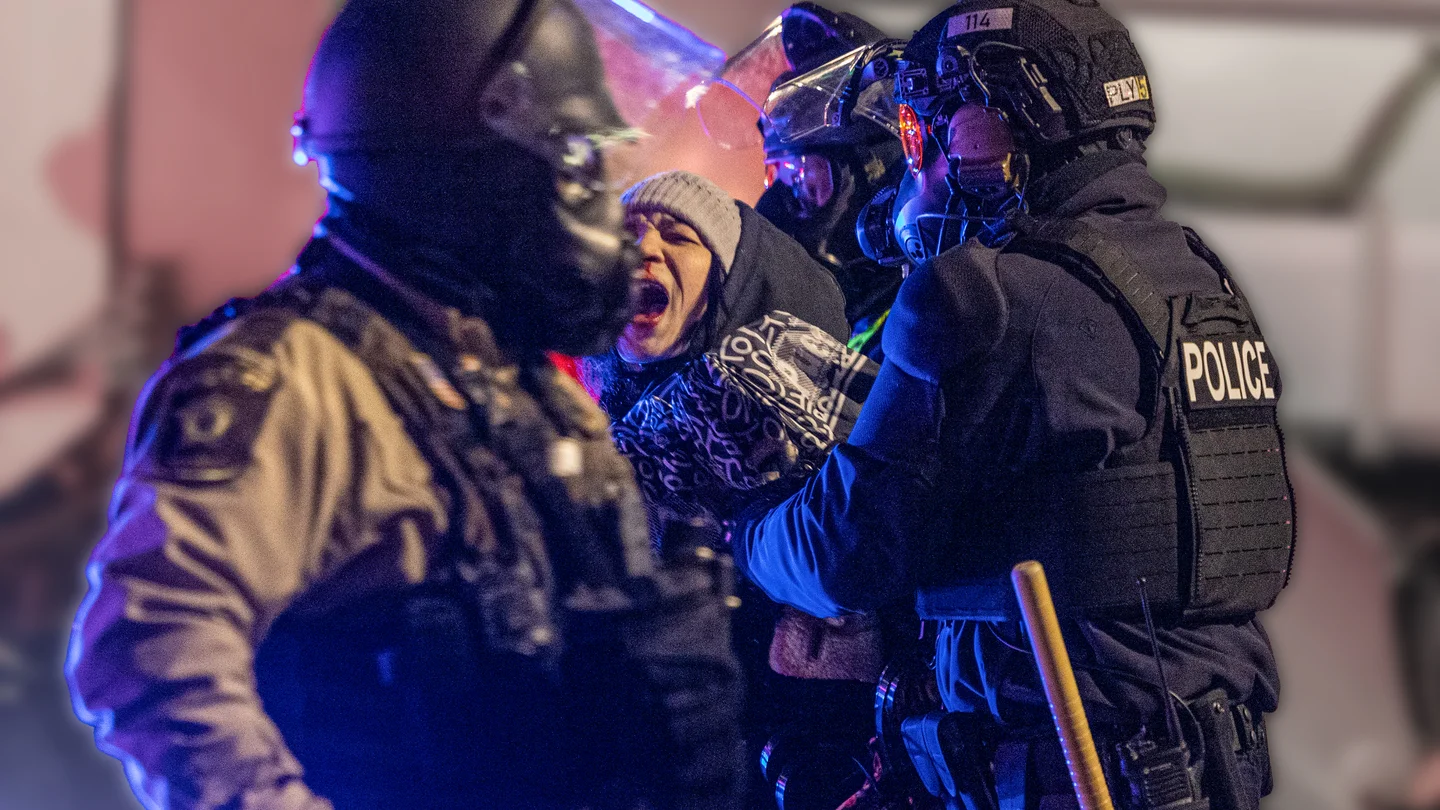
A similar dynamic is evident in the U.S. government’s deployment of ICE agents and surveillance tactics within its own borders. In cities like Minneapolis, Chicago and Los Angeles, ICE agents have deployed chemical irritants early in confrontations with protesters, used so-called less-lethal munitions at protesters (some who’ve been blinded), and are utilizing facial detection apps, databases, cell phone trackers, and drones to track immigrants and protesters. (The same thing happened in the efforts to suppress Black Lives Matter protests in 2020.)
The feds have also drawn on counterterrorism strategies used by the Israel Defense Forces (IDF) when deploying tactics in blue cities, said Julian Go, a professor of sociology at the University of Chicago and author of “Policing Empires: Race, Militarization and the Imperial Boomerang.”
HuffPost recently spoke to Go about his timely book, the racialized history of the “imperial boomerang,” and how imported tools and tactics developed in foreign territories are now being used on protestors in cities like Minneapolis.
HuffPost: First, how do you define the ‘imperial boomerang,’ or the ‘colonial boomerang,’ as it’s also called?
Julian Go: The “imperial boomerang” concept refers to the process by which imperialism abroad comes home to impact the imperializers themselves.
These imperial tools and tactics are first innovated and perfected in the imperial periphery ― that is, in colonies, at imperial borders, zones of violent conquest and war like Vietnam or Iraq ― primarily for use on peoples racialized as nonwhite and seen as inherently dangerous, violent ... and barbaric. That is how colonial control and wars of conquest are justified in the first place: that “those people” only understand violence. So it’s racialized from the get-go.
What about what we’re seeing in Minneapolis with ICE and Border Patrol agents? Are those groups’ interactions with civilians a byproduct of the imperial boomerang?
Go: We see the imperial boomerang most with the police. But while U.S. Border Patrol and ICE are separate from local police departments, they can also be seen as impacted by the imperial boomerang. Border Patrol first emerged in the late 19th and early 20th centuries and was primarily deployed along the U.S. border with Mexico, and they borrowed tactics and tools of America’s military conquest of the west. Many of the first U.S. Border Patrol agents came from the Texas Rangers, for example.
ICE was created in 2002, so its history is more recent. But yes, we can still see the boomerang at work. Research done by Jewish Voice for Peace reveals that ICE agents had, along with various U.S. police officials, traveled to Israel to learn how the Israeli police and military dealt with Palestinians.
Or consider the previous head of ICE operations in L.A., Chicago and Minneapolis: Greg Bovino. Before being appointed to his role by Secretary of Homeland Security Kristi Noem and before he launched those operations, Bovino had deployed to foreign assignments in Honduras, Egypt and Africa. He also cut his teeth with the Border Patrol in the southwest and California, where the militarized Border Patrol developed and deployed rough if not violent methods (and also reportedly illegal methods) for locating and rounding up undocumented migrants in border zones. We see these methods in Bovino’s campaigns in L.A., Chicago and Minneapolis, which are very different urban theaters than the border zones where those methods were initially operationalized.
In this sense, the ICE campaigns in cities like Chicago or Minneapolis are effects of an imperial boomerang: The aggressive tactics for rounding up migrants at the peripheries of the American empire — the border — are being used on the streets of America’s urban heartlands. America’s cities are treated as colonial zones of conquest and imperial borderlands because that’s all ICE knows. If all you have is a hammer, everything looks like a nail.

As you mentioned, the increasingly militaristic nature of policing in the United States is a direct result of the imperial boomerang. How can you trace that?
Go: The first police department in England, the London Metropolitan Police, was created in 1829 and was inspired by colonial policing in Ireland and slave patrols in the British Caribbean. The first U.S. police departments in the 19th century copied the London Metropolitan Police while bringing in inspiration from America’s own colonial history of westward expansion. In the early 20th century, modern police departments imported tools and tactics from America’s colonial war of conquest in the Philippines. Policing tactics and technologies like pin-mapping ― whose modern-day high-tech version is known as “spot mapping” or “predictive policing” ― or mounted police were all inspired by the American army’s brutal colonization of the Philippines.
During and after the Vietnam War, police in the U.S. imported counterinsurgency methods and even torture methods that were used in Vietnam. SWAT units were inspired by military units in the Southeast Asian theater of war. Veterans of the Vietnam War served in police departments and helped bring these tactics and tools back. In the early 1970s, British and U.S. police imported methods of crowd control from Northern Ireland.
Police departments now use tactics and surveillance technologies developed and used in the Middle East amidst the so-called “war on terror.” The so-called “gang databases” that police in many U.S. cities use come from technologies developed for the U.S. Army by Palantir. Police officers have gone to Israel to train and study Israeli methods of managing so-called terrorism. They then bring back the lessons learned from these zones of colonial conquest and war.

You write that we often see the ‘imperial boomerang’ come into play in response to perceived racialized threats from minority and immigrant populations. Explain.
Go: Historically, and currently, police tend to import tools, tactics and technologies from the periphery for domestic use when they perceive a crime wave or imminent threat to social order from nonwhite populations. Think of Chinese gangsters and their opium dens in California in the early 20th century, Black Americans in urban centers in the 1960s, or Muslim populations in post-9/11 America. They then use the imported violent methods and forms of control primarily on these nonwhite populations and justify their use on racial grounds, constructing the targeted nonwhite populations as inherently criminal or some kind of radical threat to society.
While racist perceptions about threats to law and order are often the motivation for bringing the boomerang home, and while the imported policing tools and tactics are primarily deployed on nonwhite populations, those tools and tactics remain available for use on any populations. While initially meant for nonwhite people or noncitizens, they can be readily deployed on white citizens, too. And they have been used on them. Militarized policing ... has been directed at everyone from white striking industrial workers in the early 20th century to white college student protesters in the 1960s. Racism has been the Trojan horse by which militarized policing has been snuck into the United States, to be directed at anyone.

Race is clearly a factor in these mass deportation efforts; ICE continues to disproportionately target Latino communities, including Mexican Americans and Mexican nationals.
Go: Yes, as with other instances of the boomerang effect, the entire ICE campaign is premised upon a racialized threat, which is exaggerated, if not entirely false.
Trump and the DHS justify ICE operations and their methods on the grounds that undocumented immigrants are all violent criminals posing a threat to law and order, that America’s blue cities are spaces of chaos and violence like border zones or colonial fields of conflict. The only way to handle the so-called “problem” is through militarized methods imported from the imperial peripheries. No other methods are considered except the most militarized and violent methods taken from border zones. Based on my research into policing and the boomerang effect, these racist and feverish fears of presumed criminal immigrants that justify ICE are all too predictable.
What’s also predictable is the way in which ICE’s tactics have impacted everyday citizens, too. As with the boomerang effect in the past, the imported tactics and tools are being directed at all populations. The killings by ICE of Renee Good and Alex Pretti are examples of this.
Do you think there are any meaningful ways for the average American to check the growing militarization of our borders and immigration infrastructure?
Go: I think the Minnesota protests have made it obvious: Citizens can march and make their opposition known. This is important: One of the only heartening things about the Minneapolis situation is that it shows that the boomerang can be at least halted somewhat. In past cases of the boomerang, historically speaking, citizen opposition to police militarization emerged ― when it emerged at all ― only after it was too late ― as in, only after the boomerang had already returned.