


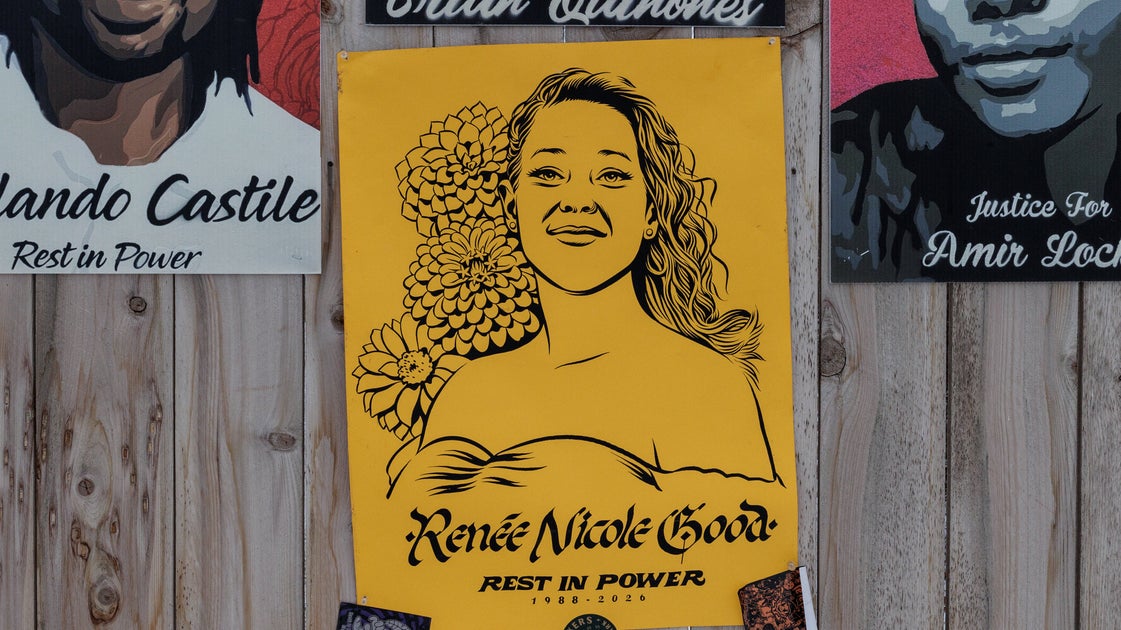
In the weeks following the deaths of Renee Nicole Good and Alex Pretti at the hands of federal agents in Minnesota, there have been countless dissections of the events of each shooting — the moves of all parties slowed down, paused and rewound ad nauseum.
One detail in Good’s death in particular is something that has lingered in the minds of countless women (and those who love them) since: the video footage showing that in the seconds after the agent, later identified as Jonathan Ross, shot Good in the head, he referred to her as a “fucking bitch.”
And it’s that detail that seems to be a pretty accurate temperature read for how Immigration and Customs Enforcement has been reacting to women who are protesting and observing in Minnesota, as Megan J. Peterson, executive director of Gender Justice and Gender Justice Action, a Minnesota-based gender equity organization, told HuffPost.

“We are seeing basically in the reports that are coming in that, it’s not just [Good] who he called a ‘fucking bitch,’” Peterson said. “That is now a popular refrain that ICE is using when encountering women protesters and ICE Watch folks. We’ve definitely gotten reports of that in an ongoing way.”
She said her organization, which launched a tool for reporting gender-based violence from federal law enforcement after the killings, also found that ICE agents were “making comments to women that ‘they should be home with their children,’ making disparaging comments about women’s appearances ... and the systematic misgendering and mistreatment of trans women in detention.”
The misogynistic and anti-queer sentiments on display following Good’s death were hard to miss: a mix of insults about and erasure of her queer identity and family and derogatory comments on her appearance in right-wing circles that labeled her a “domestic terrorist” despite the same footage that included the “fucking bitch” comment revealing her disarming last words: “I’m not mad at you.”
To probe more at the complicated gender dynamics we’re seeing with ICE and women who oppose them — and to understand how exactly it got this bad — HuffPost spoke with Peterson and other experts in gender dynamics and inequality.
Anyone can be an ICE agent. But it helps to understand who recruitment is really working on.
To understand the gender dynamics of ICE, it helps to understand how the sausage is made. Or recruited.
It’s no secret that both iterations of the Trump administration have historically been full of posters — people who are online and aware enough of the various far-right meme ecosystems out there. And the messaging coming from official government channels in the past year is kindred to a lot of the messaging in those ecosystems: from “trigger the libs”-style posts that violate the social contract to propaganda-style posts steeped in white supremacist lore.
It helps that there is a sufficiently disillusioned and antisocial demographic more than ready to receive the call to action. Within it includes much of what you might know as the “manosphere” — which features an audience of very online, often very angry men who navigate relations with women in regressive and adversarial ways and create and consume content around fitness, lifestyle and dating “advice” steeped in ambient misogyny, self-loathing and weird junk science.
“As for who is attracted to policing institutions, I think it’s very consistent for years now: We know that men who identify with this image of hegemonic masculine power, separate spheres for men and women, gender hierarchies, sexual hierarchies, are much more likely to gravitate toward those more authoritarian structures in society,” Soraya Chemaly, author of “All We Want Is Everything: How We Dismantle Male Supremacy” told HuffPost. “That includes conservative religions. It includes policing agencies, border patrol agencies — that’s pretty consistent.”

Chemaly noted that while there is a strong presence of straight, white and Christian men, the messaging doesn’t only reach them, but many men of color (and conservative women) too.
“The right very effectively created a message of masculine restoration that appealed to men across demographic groups. We saw that in the election: Hispanic men, Black men, particularly immigrant men [who are] new to the country who maybe had citizenship, also really were very supportive of Trump.”
She notes that it “sort of makes sense, because when you’re experiencing economic stress, status, anxiety and existential uncertainty, you seek out security and comfort, and you can seek that out in what you know.” And what a lot of men “know” and cling to is a “masculine identity” that is “out of sync with modernity,” she said.
“There’s a masculine identity in which you can have honor and respect. That masculine identity, which cuts across languages, cuts across nation states and cultures, is really pegged to this very conservative idea of protecting and providing,” she said. “And that idea is how many, if not most men’s identities are shaped. The problem with it is that it is completely dependent on the vulnerability of women and children. Because if you don’t have vulnerable people, who are you supposed to protect? If you have a spouse who can earn her own way, who are you supposed to provide for?”
This hits on a similar point that sociologist Michael Kimmel made in his 2013 book “Angry White Men: American Masculinity At The End of An Era,” that there’s an “aggrieved entitlement” that we are reckoning with in real time. The framing among many American men is that the ground gained in the name of equality took something from them that was decidedly and rightfully theirs. You hear it in the manosphere railing against DEI, in the Rockwell-esque “wasn’t life so much simpler when women couldn’t have bank accounts” memes of white-picket-fence families and the yearning for a past that didn’t quite exist (but sure did sell a lot of home appliances).
It’s also compelling to outsource the causes of your distress: it’s their fault.
- Michael Kimmel, former Stony Brook University distinguished professor of sociology and gender studies
Ultimately, this manifests when these individuals encounter the financial and economic realities that kneecap us all — and can only process it in this myopic way: not “this shouldn’t be happening to us all” but “this shouldn’t be happening to me.”
And for a demographic of men who aren’t quite keeping up with the changes (women gaining more autonomy and opportunity, the “economic arrangements” that do not exclusively favor them), Kimmel said, “you can see that these appeals to being able to fulfill this basic mandate of American male identity are obviously quite compelling.”
Further, Kimmel said, you can track how, to a would-be ICE agent who fits this profile, “It’s also compelling to outsource the causes of your distress: It’s their fault ... anyone who threatens ‘their’ jobs, ‘their’ way of life. Racism, antisemitism, misogyny — the MAGA trifecta.”
We’re seeing now what happens when “male supremacist” authority is challenged.
For Chemaly, whose latest book digs deep into the ways “male supremacy” (much like white supremacy) defines so much of our current reality, the events of the ICE killings in Minnesota represent a more chilling grappling for control.
“That’s important for male supremacy. There’s a fundamental structure to supremacist worldviews — they’re hierarchical, they’re binary, they require violence, policing, authoritarian beliefs, etc.,” Chemaly explained. “ICE itself is a hyper-masculine militarized policing force and the government is using it as a way to discipline a population that is in effect feminized, that is vulnerable, that is being controlled, that is being told what to do, how to do it, where to be in a space. When people resist that, they are being punished for resisting it. “
“It’s pretty clear that they’re interested not just in controlling space or dictating where and what people can do and say, but that they’re punishing solidarity,” Chemaly continued.
As for the more flagrant behaviors that potentially violate their own policies on use of force (and the gap in clear accountability for those involved), Chemaly said we’re seeing a “free expression” of violence “with authority.”

“When Trump stood up and said ‘I’m going to restore you to your former place of glory and status,’ along with that came, ‘and allow you to act without accountability,’” Chemaly said. “That quality of not being accountable is also important to that sense of masculinity. Certainly women aren’t going to hold you accountable. Minorities aren’t going to hold you accountable — because that’s just shameful and dishonorable.”
Peterson also notes that men are certainly not exempt from being “punished” in this same way, especially if they refuse to or fail to adhere to the same standards of masculinity or offer up resistance, as seen in Pretti’s killing.
“As someone who pays attention to gender in society constantly every day, one of the things I find so interesting about the Minnesota story so far is that we have Alex, who’s a nurse, who was helping a woman stand up, who was directing traffic, who got shot in the back,” Peterson said.
“I think the fact that he is a man and also was in a caretaking role, in a community protecting role, is a way in which that old neat division of men versus women, masculinity against femininity, just doesn’t hold anymore,” she continued. “It exemplifies the ways in which we do need to think about toxic expressions of masculinity versus the very healthy, emotionally intelligent expressions of masculinity that Alex Pretti represents so tragically and beautifully.”