


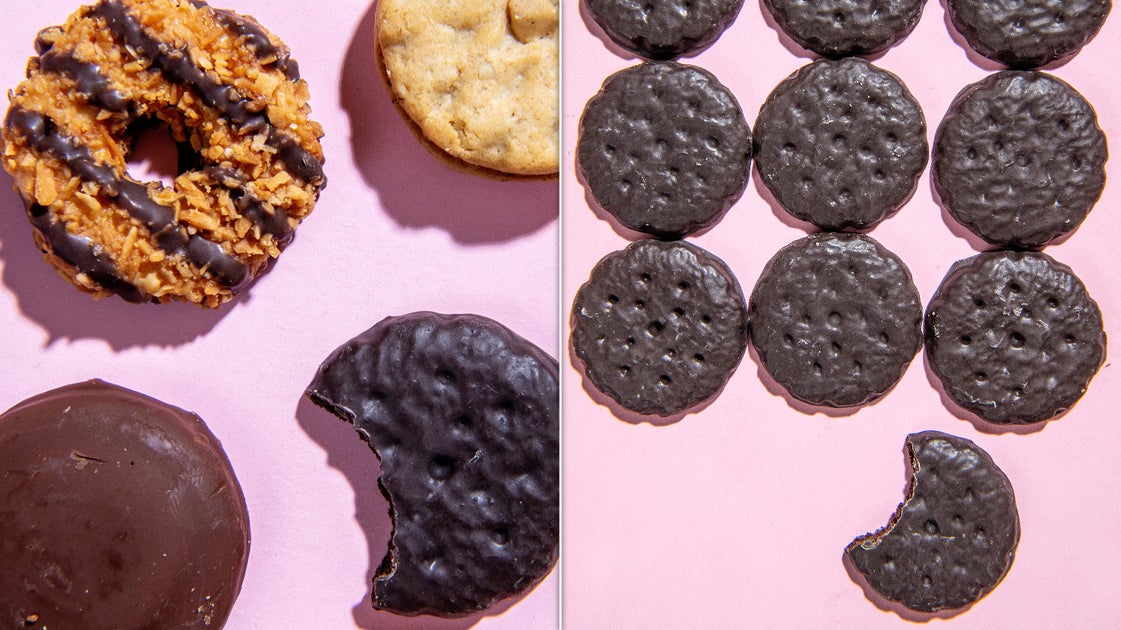
It’s Girl Scout Cookie season, which means we’re likely loading up on Samoas, Tagalongs, Do-si-dos and Lemonades. All of these flavors have their supporters and their merits — but many would argue that the MVP of the Girl Scout Cookie lineup has to be the classic Thin Mint.
And while these crispy, chocolate-covered discs are perfectly good at room temperature, many people believe Thin Mints really come into their own when you pop them in the freezer.
We had to know whether there’s any scientific merit to the claim that they’re better frozen. Does the temperature affect the flavor or texture? We asked a dietitian and a psychologist about the food science and the pleasure center aspects of this topic, and we have some answers for you.
Freezing Thin Mints can boost the sensation of menthol, making the mint flavor more pronounced.
While the chocolate coating on a Thin Mint is a nice bonus, the starring flavor of this cookie is right in the name. Dietitian Meridan Zerner told us Thin Mints’ refreshing mintiness can be amplified by a temperature drop.
“When you freeze the Thin Mint, the cold temperature better activates the mint (which contains menthol) to create even more of a cooling effect,” Zerner said. Menthol, a compound naturally found in the mint plant, is responsible for the refreshing sensation caused by eating mint, and it can also ease nausea, gas and bloating.

When chilled, the mint flavor caused by the menthol content “stands out more and can taste more intense,” Zerner added. And because mint has a more distinct scent than chocolate, the freezing process (which always reduces food fragrances) can nudge the balance of the Thin Mint’s taste more toward mint. “Flavor is largely smell or aroma-driven, so when you freeze the cookie, the chocolate may be less pronounced, which allows the mint to take center stage,” Zerner explained.
Lori Bohn, a nurse practitioner focused on sensory processing at Voyager Recovery Center in California, told us that “temperature itself is a sensory input processed by the brain alongside taste and texture, and it can amplify or dampen certain flavor notes.” In more specific terms, freezing Thin Mints will trigger “cold sensations [that] can activate trigeminal nerve pathways also involved in detecting cooling compounds, making mint-flavored items feel especially vivid and refreshing.”
Chilling the cookie can also heighten its crispness.
The amped-up mint flavor of frozen Thin Mints accounts for a big part of these treats’ popularity, but that’s not the whole story. “Regarding texture, freezing would change the cookies’ structure in that the fats in the cookie firm up, the sugars crystallize more, and the cookie becomes more crispy or snappy,” Zerner said. That shattering crunch when you bite into a frozen Thin Mint will then give way to an indulgent experience as the cookie starts to melt. According to Zerner, “When frozen, the fat in the cookie melts more slowly in the mouth. The flavor [being] released slowly may increase the perceived richness.”
The way the cold cookie interacts with the brain’s pleasure center relates strongly to the heightened flavor and texture caused by freezing. “When a cookie is very cold, the texture becomes firmer and the chocolate coating has a more pronounced snap, which heightens tactile feedback in the mouth. That crisp break can make the eating experience feel more satisfying because our brains are highly responsive to contrasting crunchy versus creamy, solid versus melting,” Bohn said.
Essentially, the nation’s collective love for frozen Thin Mints comes with clear science-backed support. The Girl Scouts of America have known how to crack this code for decades now, and all we need to do is give in and add a few more boxes to our annual cookie orders.