


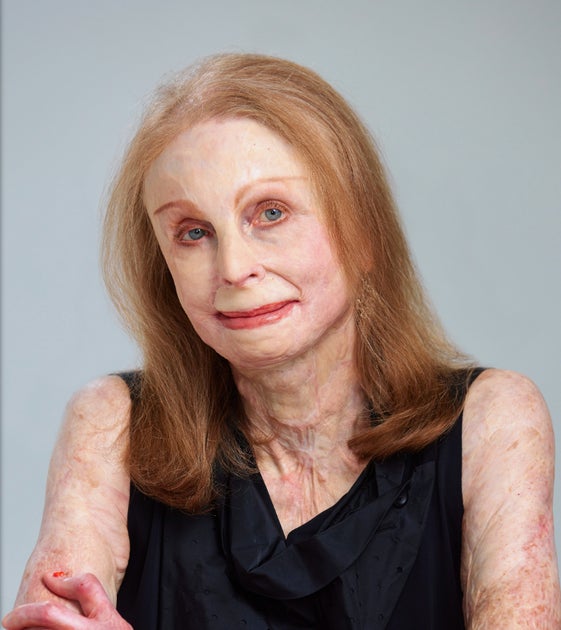
The last time I saw a face wrapped in bloodied gauze, it was mine.
In March of 1994, I was in my fiancé’s private plane when it crashed and burst into flames on Cat Island, Bahamas, a remote island with no emergency services or hospital. Days later, he died.
I survived with second-and third-degree burns over 64% of my body, including my face. In the burn unit, my head and face were bound in sterile gauze, with openings for my eyes and mouth so I could breathe. Those bandages meant I had survived.
My new injuries brought a disturbing reality to light: that all over film and television, physical imperfection — especially any sort of facial disfigurement — indicates evil. The idea of “terror stemming from disability,” as author and pop-culture essayist, critic Kristen Lopez calls it, was and still is, everywhere.
For decades, burns and facial scars have been linked to villainy or violence—think Harvey Dent/Two-Face (“Batman Forever,” “The Dark Knight”), Dr. Isabel Maru (“Wonder Woman”), and Donald Cooperman (“Goliath”). Even protagonists like Peyton Westlake in “Darkman” and Racine and Anaia in the recent revenge film “Is God Is” are depicted as burn survivors driven to violence and murder by revenge.
Disfigured faces like mine aren’t warning labels, but Hollywood keeps teaching audiences to see us this way.
This week, the online conversation is about a new body horror film, “Clayface,” based on the DC Comics character — a textbook example of disfigurement turned into monstrosity. What is this campaign teaching audiences to feel when they see a disfigured face? Warner Bros. apparently moved the film’s release from September to Oct. 23 to position it as a Halloween event, promising a frightening, disfigured face as the ultimate scare.
To be transparent, I have not seen “Clayface.” I am responding to what its marketing already asks audiences to do, which is “look fear in the face.”
The official trailer shows Matthew Hagen (played by Tom Rhys Harries) wearing a molded mask, much like the compression masks burn survivors wear to flatten scars, except his conceals his face. Dr. Caitlin Corr (played by Naomi Ackie), urges him to show her. Before he does, the film cuts to his handsome former self. Then comes the risky experimental procedure meant to restore it, and the line that sums up the premise: “Even if it kills me, I’ll be better off than I am now.”
This is one of the oldest myths about people like me: better dead than disfigured. In her book “Saving Face,” sociologist Heather Laine Talley describes how society treats facial difference as a “socially deadly condition,” a belief that makes nearly any risk to “fix” a face seem reasonable. Research on facial disfigurement has consistently found that severity does not predict how well a person adjusts, how they see themselves, or their quality of life. For the past 25 years, I have supported people with facial disfigurement through one-on-one peer mentoring, support groups, workshops, retreats, and conferences nationwide and in Canada. We are not all desperate to be fixed to fit into society’s unrealistic standards of beauty.
I don’t care that my right earlobe is melted, or that scars cover most of my face and body. Instead, I’m grateful for a body strong enough to have survived and endured immeasurable physical and psychological pain, and more than 60 surgeries.
Much of the harm we endure comes not from our faces but from how others react to them, when strangers look down to avoid making eye contact, or a restaurant guest asks to be moved to a different table away from me. Most people may never knowingly meet someone with a facial disfigurement, but they see us on screen repeatedly, and almost always in the same role. Literary scholar Katherine Schaap Williams calls it the “stereotype of the disabled revenger.”
The misrepresentation is everywhere you look. Darth Vader’s unmasking in “Return of the Jedi” reveals a pale face ravaged by lava burns, as if the scars were his evil made visible. The Phantom of the Opera’s unmasking is staged as horror. One of last year’s most acclaimed films, “One Battle After Another,” gave its white supremacist a third-act disfigurement designed to make audiences gasp.
Researchers, in a JAMA Dermatology report, found that six of the top 10 film villains of all time have visible skin conditions such as scars, burns or alopecia. None of the top 10 heroes do. In a survey by the British charity Changing Faces, only 1 in 5 people with a visible difference had ever seen someone like them.
Another study published in Empirical Studies of the Arts analyzed top-grossing films in the U.S. over four decades and in India over two decades. Of these films, 61 (31%) featured a character with a facial difference. Of the 98 characters identified, 61 were villains, and 37 were heroes. Burn prosthetics were the second most common form of disfigurement portrayed. The authors called for continued attention to cultural practices that reinforce negative stereotypes towards already stigmatized groups.
Every October, scars and burns are sold as masks. This year it has reached the toy shelf. Funko is taking preorders for a Matt Hagen figure “in a terrifying state.” A theater-exclusive “Clayface” souvenir cup features a grotesque melting face. Our faces become Halloween merchandise.
Michelle Lauren Anderson, writing for the Phoenix Society for Burn Survivors, recalled a Halloween party guest asking how she got her skin to look “so scary.” Anderson replied, “Too bad it’s real,” before leaving to cry in an empty room. She issues a clear warning: “Don’t use scars as costume.”
Burn surgeon Dr. Jason Heard, himself a burn survivor, has written that the portrayals in movies, television and comic books have seeped into our subconscious, “leading many to unconsciously view burn survivors as frightening, disfigured individuals who can’t reintegrate into society or lead normal lives.”
That is why Face Equality International, an alliance of facial difference organizations worldwide, runs its “Fear No Face” campaign this month. Its message is simple: “People with facial differences are not villains, costumes or objects of pity.”
To be fair, trailers for movies with disfigured characters are sometimes more complex than the marketing indicates. In “Clayface,” Hagen blames his downfall on betrayal, not on his face, and DC says the film explores “the dark underbelly of scientific ambition,” per a piece in the LA Times. Is it possible that beneath the gore, “Clayface” is a story about a society so scared of an altered face that it drives a man to destroy himself trying to escape his own? If so, I will say so.
Either way, no movie studio should not sell fear of our faces for six months, even if the backstory is more nuanced.
Not everyone with a facial disfigurement can meet a stranger’s stare with an invitation, nor should they have to. Hollywood wrote this script; Hollywood can rewrite it. When someone stares a moment too long, I’ll invite them to look again. They won’t find a monster. They’ll find a person who has been living a full life all along.