


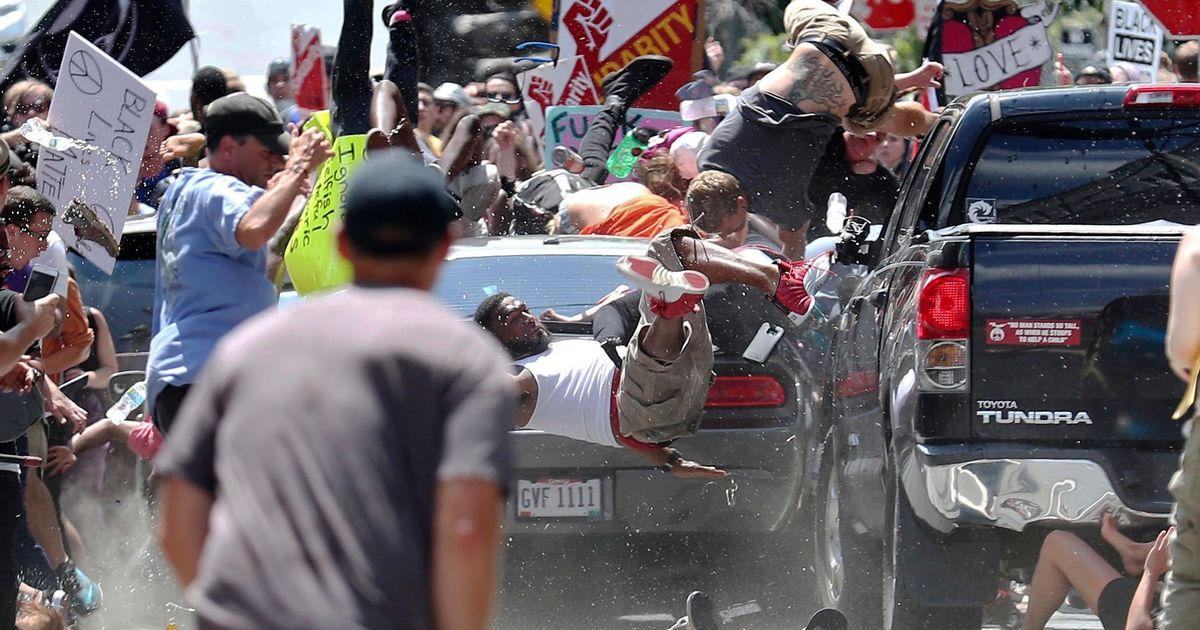

A white supremacist kills nine black churchgoers in Charleston, South Carolina. A neo-Nazi drives his car into a crowd of anti-racist protesters in Charlottesville, Virginia, killing one person and injuring 19 others. A left-wing activist opens fire on Republican congressmen practicing softball near Washington, D.C., nearly killing the House majority whip.
None of these attacks were charged as ― or could have been charged as ― acts of domestic terror by the federal government. Americans want that to change.
Sixty-eight percent of Americans say there should be a federal criminal law against domestic terrorism, according to a new HuffPost/YouGov survey. Nearly half conceded that, before taking the survey, they were unaware that there wasn’t a federal criminal law that broadly outlaws acts of domestic terrorism. Another 24 percent weren’t sure if they’d heard that fact before.
Americans who said they previously didn’t know there wasn’t a federal crime of domestic terrorism were even more likely to say that should change: 83 percent of them said there should be a federal criminal statute against domestic terrorism.
“The fact is, while the U.S. Code defines the phrase ‘domestic terrorism,’ there are currently no penalties attached to that definition. Therefore ‘domestic terrorism’ is not a crime in and of itself under federal law.”
- FBI Special Agent Thomas O'Connor
It’s “not surprising” that a lot of Americans don’t realize domestic terrorism isn’t a federal crime, said FBI Special Agent Thomas O’Connor. He is the head of the FBI Agents Association, which has been working with the bureau and Justice Department, as well as lobbying congressional leaders, to create a federal criminal domestic terrorism statute.
“Most American assume that ‘domestic terrorism’ is a federal crime,” O’Connor said this week in a statement issued to HuffPost in his capacity as head of the FBIAA. “The fact is, while the U.S. Code defines the phrase ‘domestic terrorism,’ there are currently no penalties attached to that definition. Therefore ‘domestic terrorism’ is not a crime in and of itself under federal law.”
“Congress can quickly and easily end this confusion and fix the problem by amending the U.S. Code to make domestic terrorism a crime subject to specific penalties that apply irrespective of the weapon or target involved in the crime,” he added.
The HuffPost/YouGov survey found that support for a federal domestic terrorism law was bipartisan: 82 percent people who voted for Hillary Clinton, and 69 percent of people who voted for Donald Trump, said there should be such a law.
Forty percent of Clinton voters thought domestic extremists posed a greater threat to the United States than foreign extremists, while 49 percent of Trump voters thought foreign extremist groups like the Islamic State were more of a threat. Just 3 percent of Trump voters though domestic extremist groups were a bigger threat, while 6 percent of Clinton voters thought foreign terrorist organizations were a bigger threat. (Forty-nine percent of Clinton voters thought domestic and foreign extremists posed an equal threat.)
There was a significant gap between Clinton and Trump voters in terms of how they judged the government’s response to domestic extremist threats: 75 percent of Clinton voters thought the government didn’t take domestic extremism seriously enough, while just 34 percent of Trump voters agreed.
Use the widget below to further explore the results of the HuffPost/YouGov survey, using the menu at the top to select survey questions and the buttons at the bottom to filter the data by subgroups:

The U.S. Code defines the term domestic terrorism, but there’s not a criminal statute that lays out penalties for attacks motivated by extremist ideologies.
Some types of violent acts committed by domestic terrorists can be charged under other federal laws, but the government has more tools to use against foreign extremists ― which results in disparate outcomes for Muslim and non-Muslim violent extremists.
Take, for examples, the prosecutions of Sayfullo Saipov and James Alex Fields Jr. Saipov drove a rented truck into a bike path in lower Manhattan last fall, killing eight people and injuring a dozen. Fields is the neo-Nazi accused of driving his car into a crowd in Charlottesville last year.
Among the slew of federal charges Saipov faces is a count of providing and attempting to provide material support to ISIS — a terrorism charge. He also faces eight counts of murder in aid of racketeering and 12 counts of attempted murder in aid of racketeering because federal prosecutors have labeled ISIS a criminal enterprise. Fields, meanwhile, faces a state charge of first-degree murder. Even though Attorney General Jeff Sessions said the attack was “the definition of domestic terrorism,” he hasn’t been charged with any crime on the federal level, let alone a terrorism-related crime.
Sixty-five percent of Americans think the attack in Charlottesville counts as terrorism, according to the HuffPost/YouGov poll. Twenty percent said they weren’t sure, and 15 percent said the attack wasn’t terrorism. Clinton voters were more likely to think the Charlottesville attack was terrorism: 80 percent said it was, compared to 63 percent of Trump voters.