


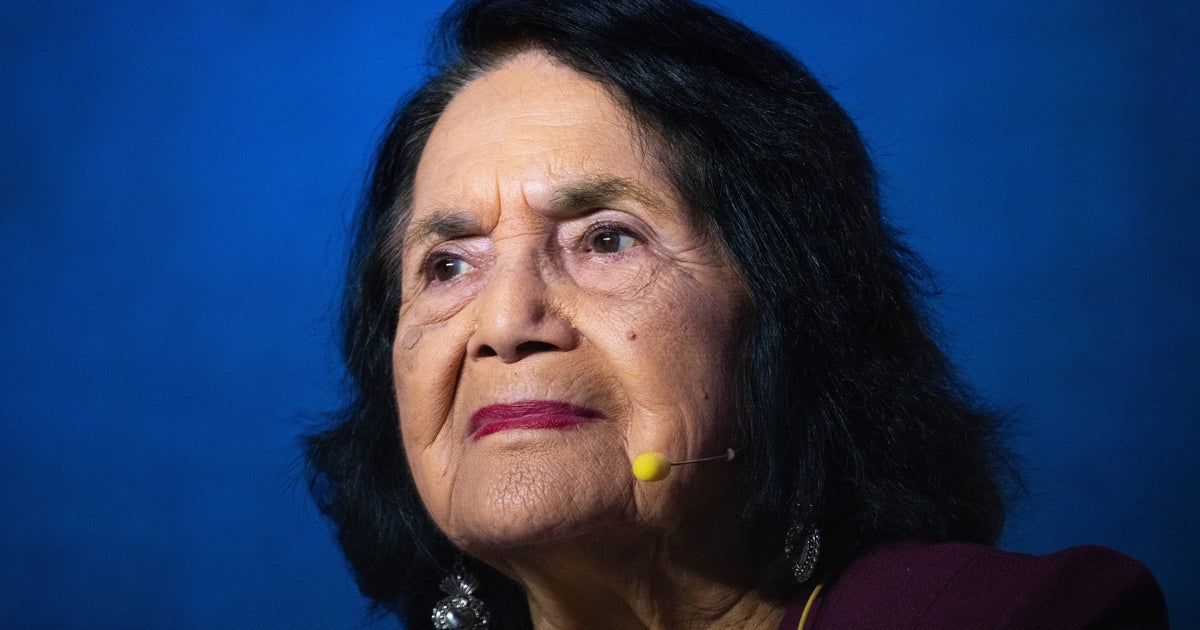
Dolores Huerta, a major civil rights leader who with Cesar Chávez helped lead the farmworker and labor movement in California, died Wednesday at 96, according to her family.
“We are deeply saddened to announce that our beloved mother, Dolores Huerta, has passed away today at the age of 96,” the Huerta family posted on Facebook.
“As you can imagine, this is an incredibly difficult time for us, and we ask for privacy as we grieve this incredible loss to our family,” the statement continued. “We know that many of you around the world share in our mourning, and we will be following up on plans to recognize and celebrate her incredible life and legacy.”

Dolores Clara Fernández was born in New Mexico in 1930 to a father who was a farmworker and miner and a mother who worked as a waitress and later ran a small hotel. Huerta herself was a twice-divorced single mother to 14 children.
Stockton, California, where she and her two brothers moved at an early age with their mother after their parents’ divorce, was a diverse community with many agricultural worker families.
Huerta got a teaching degree from a local community college and taught briefly before becoming an organizer, after seeing her students come to class with “empty stomachs and bare feet,” per her organization’s website.
A Mexican American icon, the labor leader and feminist dedicated her life to fighting for the civil rights of poor migrant workers. She founded the Agricultural Workers Association in the 1950s, which helped register voters and advocate for community improvements. Dolores and Chávez, who met working in the Stockton Community Service Organization, co-founded what became known as the United Farm Workers.
As Chávez’s second-in-command until his death in 1993, Huerta helped lead strikes for grape workers and negotiate with agribusinesses in the 1960s and ’70s that led to some of the nation’s first union contracts for farmworkers. She also pushed for policy changes that led to the 1975 Agricultural Labor Relations Act in California, which gave the state’s farmworkers the right to collectively bargain.

In March, Huerta accused Chávez of sexually abusing her in the 1960s during their time in the California labor movement, resulting in two pregnancies. The labor leader released a personal statement following her inclusion in a New York Times exposé into Chávez’s sexual abuse of girls.
“I am nearly 96 years old, and for the last 60 years have kept a secret because I believed that exposing the truth would hurt the farmworker movement I have spent my entire life fighting for,” she wrote in a Medium post.
“I have encouraged people to always use their voice,” she continued. “Following the New York Times’ multi-year investigation into sexual misconduct by Cesar Chavez, I can no longer stay silent and must share my own experiences.”
In former President Barack Obama’s speech awarding Huerta with the Presidential Medal of Freedom in 2012 — the nation’s highest civilian award — he credited her with inspiring his famous campaign slogan “Yes, we can.” The three powerful words were a translation of “Sí, se puede,” Huerta’s labor organizing slogan in Spanish.
“When people of color are left out of history, then we see the racism that we’re looking at today, we see the misogyny, homophobia and all that. And that’s because our histories are not being told,” Huerta told HuffPost in 2017 in an interview about the documentary “Dolores,” based on her life. “People will grow up ignorant of the contributions of people of color or of women or of the LGBT community, of labor unions, etc. We have this abysmal ignorance of women inside America.”
“I think that it’s not only important for women, but it’s important for our whole society that our stories be told and that our victories and our achievements can be recorded in history,” she added.