


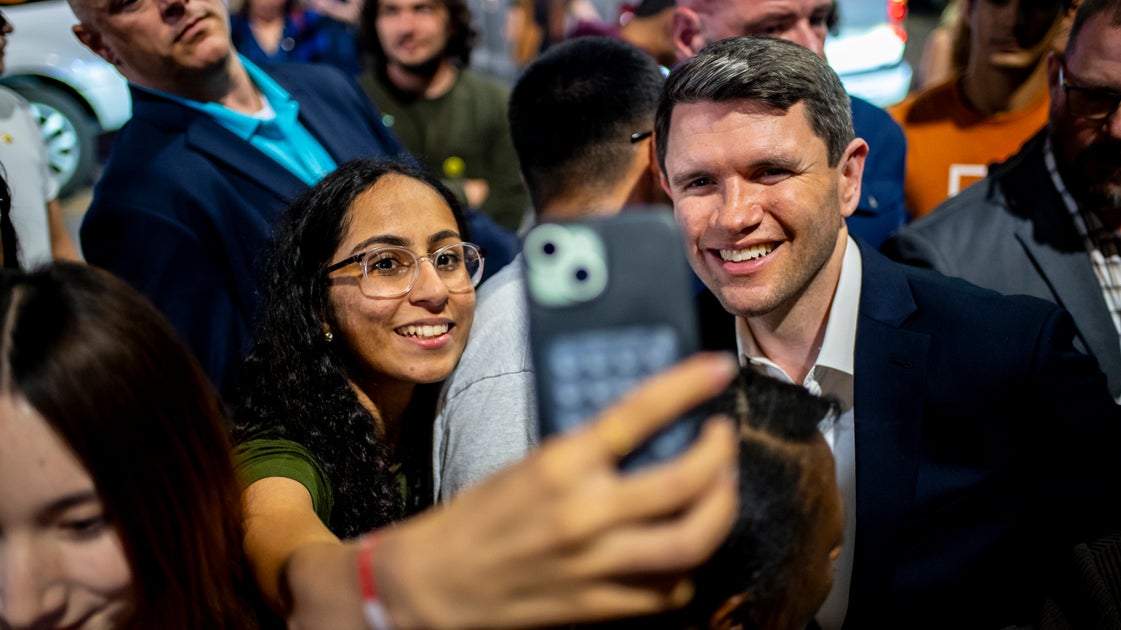
In his victory speech in the wee hours of the morning after Election Day, incoming Sen. James Talarico (D-Texas) shouted out the power of grassroots support in the face of mass spending.
“All the money in the world is no match for the people of Texas,” Talarico said. “And we just sent a message to every billionaire megadonor, every trillionaire megadonor, every corrupt defender of this broken political system in this state, in this country: Power belongs to the people.”
Talarico’s team posted the speech to his TikTok account, which is followed by over 2 million people, where it sits at a cool 158,000 views. It’s an indicator of the other type of grassroots support that proved integral to his victory.
Several marquee candidates this cycle, like Talarico and fellow Sen.-elect Abdul El-Sayed (D-Mich.), were practically main characters on video-forward social media like TikTok and Instagram Reels, and associated surrogate accounts racked up millions of views on their behalf.
They posted “Mean Girls” parodies comparing their opponent to Regina George and clapbacks to being accused of “low testosterone,” among short, snappy videos communicating their top priorities. (One, on El-Sayed team’s page, included those ideas in a reel showcasing his ‘Abdul Aura,’ borrowing from popular Gen Alpha slang.) Not to mention the dozens and dozens of edits of candidates up and down the ballot that have Made Democrats Sexy Again.
Parker Butler and Lauren Kapp, Gen Z strategists who founded the digital agency Luminary, say that campaigns are finally waking up to the truth of today’s politics: Hacking the attention economy is mission-critical to winning.
“Organic attention, in particular, is the driving force of politics,” said Butler. Luminary worked on Talarico’s social campaign and was previously part of the team behind the in/famous 2024 KamalaHQ account. He suggested that other parts of the party hadn’t fully processed this notion at the start of the cycle and may have seen social strategy as a “side project for like the kids to post their fun memes or whatever.”
That idea “has been done away with, and it’s taken a while, I think, for a lot of party operatives to catch up to this fact,” said Butler.
“You can’t just buy your way to victory anymore, and you have to be a lot more creative to break through.”
- Parker Butler, co-founder of digital agency Luminary
Texas’ Senate race was a prime example. Intermittent trillionaire Elon Musk spent a small fortune — $158 million of the nearly half a billion dollars he invested in the midterms overall — to back Texas Attorney General Ken Paxton’s U.S. Senate bid and smear Talarico in the process. While polling showed that Talarico’s unfavorables inched up with older demographics more prone to watching television ads, his favorables grew 16% from July to October with voters under 35, the group most likely to engage with his online virality, per Fox News polling.
Georgia Gov.-elect Keisha Lance Bottoms also beat a billionaire GOP challenger who significantly outpaced her in spending. And while her content was not as viral as Talarico’s — she sits at just under 150,000 followers — her team did have a presence on TikTok. (Her opponent’s account has less than 4,000 followers.)
“You see in so many of the marquee races of this past cycle, including Texas, where money did not make the difference,” said Butler. “You can’t just buy your way to victory anymore, and you have to be a lot more creative to break through.”
The more establishment-leaning wings of the party seem to have caught on, too. The Democratic National Committee’s official account, for instance, boasts over 7 million followers and has seen skyrocketing growth since the last presidential election, when Kamala’ Harris digital presence, KamalaHQ, developed a cult following. Per a DNC official, their accounts across TikTok, Facebook and YouTube have seen 501% growth in impressions since 2024 and a staggering 749% increase in engagement since then. Just this cycle, the DNC TikTok account gained 4.5 million followers, and within the past year, nearly two-thirds of its viewers (70%) were under 34.
But believing this was simply the cycle of the “fan cam” video montage is a “limited” takeaway, Kapp said. It’s not just muscular candidates in tight T-shirts that drove engagement — candidates were able to effectively communicate their platform and priorities.
“We’re entering this new era of talent within the Democratic Party, where you have millennials and younger folks that are coming into power that are scrolling in the same way that the three of us are, and that’s a very unique experience,” Kapp said. She believes much of the success of various candidate accounts can be attributed to heightened risk-taking and a rapid-response feel over manicured ads. “They’re able to show their personality, but also communicate their policy in a very genuine manner in comparison to the old guard,” Kapp said.
Candidates eyeing the White House in 2028 — as well as other Democratic Party stakeholders — are taking notice. Pete Buttigieg, Wes Moore, Gavin Newsom and Jon Ossoff all have accounts on TikTok.
And while no one is arguing that traditional ads are a thing of the past, these accounts are resonating with parts of the potential electorate that may not have been paying attention otherwise. Per Butler and Kapp, in 2024, 77% of Kamala HQ’s content was viewed from TikTok’s For You Page, rather than from a profile search or from users’ feeds of accounts they already followed. Two years later, that figure has spiked, with nearly all their content, 91%, viewed through that For You Page.
“This shows how the For You Page is increasingly the way people are viewing content online instead of from who they’re following. Organic social is becoming more like targeted ads,” said Butler.
Kapp added that compared to 2024, Democrats now have a more varied and competitive stream of amplifiers for their content and messages after Republicans long dominated the broader political influencer, podcaster and news aggregator space. (See: the manosphere.) El-Sayed’s campaign account, AbdulHQ, has over a million TikTok followers, as does Team Talarico’s Facebook page.
“These are huge assets for these incoming senators to have,” said Kapp. “The fact that they not only have large followings on their principal accounts, but have these surrogate accounts that they can rely on to amplify their messaging and create this ecosystem of accounts in order to uplift them online.”
“Not everything makes sense to post on a principal account, and it’s really important to have these other accounts that are able to lift you,” she said.