


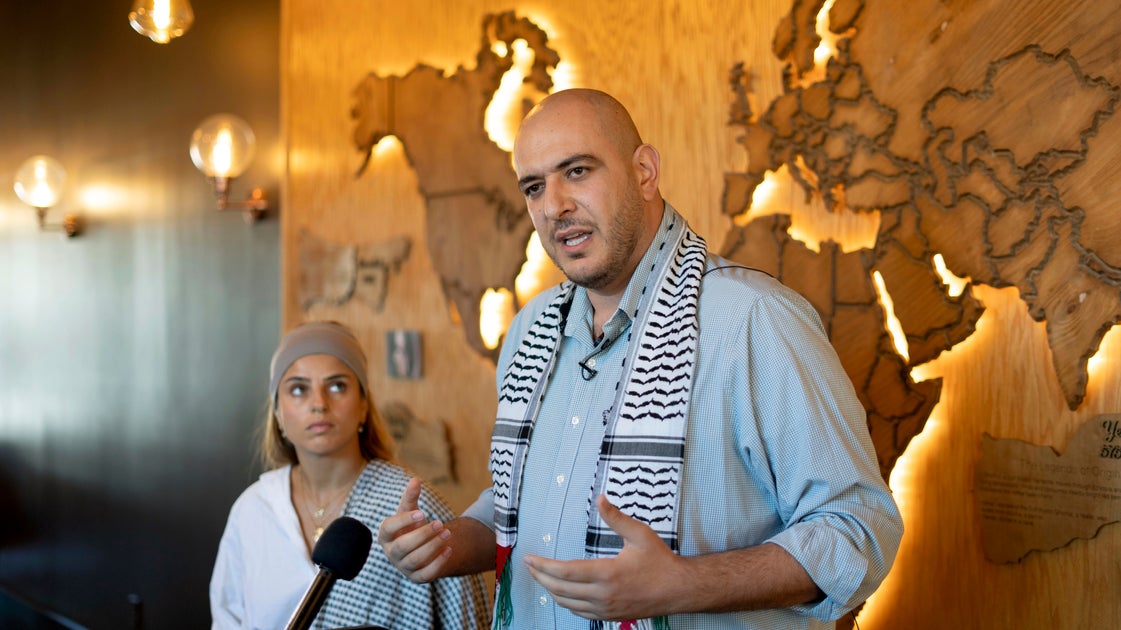
Ruwa Romman represents part of the Atlanta suburbs in the Georgia statehouse, but earlier this summer, she was knocking on doors in the Bronx because she saw New York City’s mayoral race as part of a national battle. By working to elect Zohran Mamdani, Romman hoped she was working to reshape the Democratic Party — and U.S. politics writ large.
One voter told Romman he was hesitant about Mamdani, 33, because he values experience. As they talked, a neighbor ran over. He wanted to make his own argument: “You better vote for him! … Anybody who’s willing to stand up for babies in Gaza is absolutely going to have your back.” Romman, a Palestinian American, teared up.
Mamdani triumphed in the mayoral primary, defying opponents who called him extreme for condemning Israel’s U.S.-backed offensive in Gaza. For Romman and others, the win marked a vital shift. Last year, as part of the “Uncommitted” movement — which organized hundreds of thousands of voters to tie support for the 2024 Democratic presidential nominee to their positions on Gaza — they spent months arguing the Democratic Party risked votes over Joe Biden’s unchecked support for the unpopular Israeli campaign. Their supporters included Mamdani. The party never reconsidered the policy.
“Zohran’s campaign for me really does feel like a new day, building on the anti-war organizing power we, through the Uncommitted movement and Democrats all around the country, built over the last couple of years,” said Abbas Alawieh, a co-founder of Uncommitted. “I don’t think I was able to officially get out of my post-general election malaise until Zohran won, and now I’m ready to fight again.”
The story of the 2024 movement is inseparable from two of the biggest debates among Democrats as they try to regain power: how to reform their party and how to talk about U.S.-Israel relations. Washington remains Israel’s chief backer as Tel Aviv is worsening the man-made humanitarian crisis in Gaza and quashing chances of a future peace deal involving a Palestinian state rooted in the occupied West Bank.
Exactly a year ago, at the Democratic National Convention, activism by anti-war Democrats reached its crescendo, and the party establishment — defined by Biden and sensitive to hardline pro-Israel donors — refused to make significant concessions in response, most notably by denying a request for a brief convention speech by Romman or another Palestinian American.
This week, as Democratic leaders congregated again at their annual summer meeting, a back-and-forth over two proposed policy positions on Israel ended in the rejection of an arms embargo proposal, renewed anger among anti-war Democrats and lawmakers and a pledge for a new party task force on Gaza.
It was the latest sign that the party’s response to the war will remain central to its shifting identity. Last month, 28 senators supported an effort to block U.S. weapons for Israel — a group including most Democrats in the chamber and 12 senators who previously rejected such efforts. Candidates for the party’s 2028 presidential nomination are being pushed to be direct about the war, as Pete Buttigieg recently learned after offering mealymouthed comments.
At this potential turning point, four leaders of the Uncommitted movement told HuffPost they feel a blend of hope and disappointment. They see the party evolving on both foreign policy and better representing its various constituencies, but they wish it had done so earlier, limiting damage from U.S.-backed Israeli attacks and aid restrictions and even potentially avoiding a second term for Donald Trump. Discussing lessons that could help for the future, they say the biggest is the need for urgent change.
“I do not think the people who currently control the Democratic Party are salvageable,” Alawieh said. “The Democratic Party is salvageable, and the way we salvage it is by taking away power from people who currently have power and are wielding it in favor of endless war and endless bombs, and giving that power to candidates, to operatives, to people in our party who see everybody’s humanity as one and the same — who do not see more human life when looking at an Israeli life versus a Palestinian life.”
‘A Plane Taking Off That Got Stuck Midair’
Uncommitted leaders identify two periods in their advocacy: before and after Biden abandoned his presidential candidacy.
In late 2023, protests swelled against Israel’s operation in Gaza, which was cast as retaliation for the Oct. 7 attack by Palestinian militants, organized by the group Hamas, but quickly came to look like devastating U.S.-funded collective punishment for the strip. (Israel maintains its military operations are targeted and minimize harm to civilians.)
Anti-war organizing got the Biden team’s notice, particularly in Michigan, a swing state crucial to the president’s reelection plan that has a large Arab and Muslim American community. His campaign manager, Julie Chávez Rodriguez, visited local leaders in January 2024, and after many said they wanted a summit with policymakers instead, the White House dispatched senior officials to the Arab-majority city of Dearborn on Feb. 8.
Among the invitees was Alawieh, who two days earlier had unveiled the Listen to Michigan model that would drive Uncommitted movements nationally: asking voters in Democratic primaries not to mark support for Biden, to prove it was politically important to moderate his Gaza policy.
Describing the terror he experienced as a child in Lebanon hearing Israeli jets drop U.S.-provided bombs, Alawieh asked Biden advisers Jon Finer and Samantha Power if they had urged the president to demand a ceasefire in Gaza. “You’re not going to get that answer,” White House official Steve Benjamin said of the question, though Finer expressed regret about the administration’s rhetoric, and Power, a former war correspondent, told Alawieh she knew how scary life was in a warzone.
A pattern was set: Establishment figures would hear Uncommitted out but dodge its demands.
The movement gained momentum, winning 100,000 votes in Michigan and significant numbers in other states’ primaries. Organizing was not easy, because some of the people most affected by Gaza’s pain wanted nothing to do with Democrats, and because defenders of a blank check for Israel were mobilizing, too. One Uncommitted activist in Washington state told HuffPost local right-wing commentators repeatedly tagged him and his employer in critical social media posts; he said the company eventually fired him, citing performance issues though he had received a promotion and raise a few months earlier. (The organizer requested anonymity for professional reasons.)
To the extent senior Democrats engaged with the movement, it was quietly — as when political assessments helped drive Biden to withhold a shipment of bombs for Israel in April. It was also mostly a one-way street, the co-founders told HuffPost. In May, for example, a White House official reached out asking Uncommitted to praise a planned Biden speech endorsing an end to the war, Alawieh said. (The group did not do so because the official clarified the president would not suggest cutting off firepower in calling for a ceasefire.)
Then Biden abandoned his candidacy on July 21. As Kamala Harris — less old-school and known for speaking more about Palestinian distress — took over, expectations grew that the campaign and administration might embrace ideas from anti-war voices in their political tent. Beyond activists, a growing number of Democratic politicians were questioning the U.S.’s Gaza policy, speaking of alleged Israeli war crimes and using America’s leverage as Israel’s weapons supplier to push Israeli Prime Minister Benjamin Netanyahu for a deal with Hamas to end fighting, free Israeli hostages and Palestinian prisoners and allow aid into Gaza.

Instead, the period between then and the DNC felt like “a plane taking off that got stuck midair,” Romman said. Fresh goodwill between Uncommitted and the campaign apparatus petered out within a month — mostly because of stubbornness by the latter, but also mutual misunderstandings.
Real trouble began on Aug. 7. Before a campaign rally in Detroit, Alawieh and fellow Uncommitted co-founder Layla Elabed briefly met Harris. Both requested a discussion of an arms embargo on Israel and “walked out feeling really confident,” Elabed said, describing genuine sympathy from Harris when she spoke of Michiganders losing relatives in Gaza.
Uncommitted issued a statement saying Harris was open to that conversation, a tacit enticement for anti-war voters. Then the message was amplified by Republicans, panicking Harris advisers who soon issued a rejection of an embargo.
The organizers knew Harris did not support the idea, Elabed told HuffPost, which was why they wanted to argue for it and say reconsidering could not wait until after the election; U.S.-backed Israeli attacks were killing Palestinians daily. Harris aides, meanwhile, felt ambushed and typecast, with one later telling HuffPost that the campaign’s statement was misunderstood as a blanket defense of Israeli policy despite also emphasizing that Israel should follow international law. Anxious about having only 107 days to campaign, and often hearing from pro-Israel voices with greater sway in the party than Uncommitted, they became wary of the movement.
The convention in Chicago two weeks later featured the first-ever DNC panel on Palestinian rights, and Uncommitted leaders seemed to get VIP treatment. Democratic officials handed them convention credentials “as if they were $1 million checks,” Waleed Shahid, another Uncommitted organizer, recalled to HuffPost. Yet the goodwill remained on the party’s terms: Uncommitted’s key demand for the convention — speaking slots for a Palestinian American (they said they discussed several options) and a doctor who had volunteered in Gaza — went unmet, despite an overnight sit-in and support from major party figures.
A month later, Harris had not outlined a possible policy shift on Gaza or fulfilled Uncommitted’s request to visit Dearborn to meet families with ties to Palestine and Lebanon. The group announced it would not endorse her, while strongly warning against Trump. Days later, the Biden administration supported a new military operation by Netanyahu into Lebanon. Many Arab Michiganders have roots there; Alawieh said the moment made him “certain that the people who currently control the Democratic Party would prefer that people like my family, maybe even me, didn’t exist.”
Trump vaguely promised peace, and in November, as support for Democrats tumbled among groups they had previously won, with some citing Gaza as their chief reason, he won Michigan, racking up votes in Arab-heavy areas. He tapped an ally from one such town, Hamtramck, as an ambassador.
“The lesson … my cousins are seeing is that if a local Arab American puts themselves out there for Donald Trump, they get rewarded,” Alawieh said. “If a local Arab American puts their neck out for the Democratic Party, they get rewarded by getting the privilege of sleeping outside that party’s convention, begging them not to keep a muzzle over their community’s mouth.”
With Trump’s blessing, Netanyahu has intensified his aid restrictions and battle plans in Gaza, accelerating Palestinian deaths.
Lessons Learned
Uncommitted’s experience offers signs about Democratic politics beyond 2024.
Chief among them is institutional resistance to change, regardless of how voters vote or say they feel. Party power players still set the agenda, often subtly and particularly on the most sensitive issues like Israel-Palestine. When the Uncommitted leaders spoke with an Obama-era figure after the DNC, the person told them they “never had a chance at getting a speaker,” Alawieh recalled. When he said the group had lengthy negotiations with party officials, the person retorted that might have been sincere, but the decision rested above such discussions — with “the people who paid for that stage,” namely donors.
Specific Democrats challenging the Gaza war had become obvious targets for ardent Israel supporters, who successfully unseated Reps. Cori Bush (Mo.) and Jamaal Bowman (N.Y.), but Uncommitted was attempting a so-called inside game of accepting the person leading the party — Biden or Harris — and seeking to persuade them. It became clear that successfully spurring the party’s national leader to defy pressure to defer to Israel would be bigger, however, than a series of primary wins. The Obama-era figure suggested a campaign like the effort to secure the 2015 Iran nuclear deal over Netanyahu’s objections, which involved a media blitz and consistent advocacy by lawmakers and even European officials, Shahid told HuffPost.
With many Democrats comfortable with and benefiting from the status quo, individual obstinacy and defensiveness are challenging, too. Biden advisers who dominated the campaign even after Harris’s rise often argued against differentiating her from the president, including on Gaza, citing history — but overlooking the argument that vice presidents had lost elections by failing to seem different from their bosses, notably in 1968 during the Vietnam War, a campaign aide told HuffPost. Former Harris aide Ammar Moussa and liberal commentator Matt Yglesias, among others, have publicly attacked Uncommitted, claiming it was politically unwise. Some Democrats say its activists have gone silent, though they regularly condemn Trump’s approach to Gaza and, unlike under Biden, are not part of his broad political sphere.
Organizers in the movement want the party to eventually convey respect for Americans disturbed by the Gaza war — and see, as Republicans’ growing debate over U.S. support for Israel shows, that the sentiment is a major political reality. Even far-right Rep. Marjorie Taylor Greene (R-Ga.) “is willing to fight Trump on this issue … it is the swing vote,” Romman said.
Making amends will involve seeing nuance among anti-war organizers, not dismissing the movement for political convenience. Alawieh said Democratic leaders confused Uncommitted with the “Abandon Harris” movement, while the campaign aide described the latter to HuffPost as a nuisance, not a warning sign. Plummeting conditions in Gaza since then have fueled more public anger over America’s role as Israel’s enabler; courting those with that viewpoint will likely be important in future campaigns.
For more success in future activism, Uncommitted and other anti-war organizers will need to practice introspection, too.
Shahid described a regret about strategy after watching Mamdani’s primary win. He told HuffPost he believed frustration over Gaza should have been championed by a specific candidate, running against Biden to be the 2024 Democratic nominee on “generational anti-war grounds” — a position that could possibly have also tapped wariness over Biden’s age, the factor which doomed his candidacy and left Harris with a unique, unenviable bid to finish the job.
Separately, one of the Harris campaign aides argued Uncommitted also struggled with “an inability to communicate to their own base — they got them angry but were not able to calm them down long enough to help them understand what the difference was” between Harris and Trump. They said the campaign was “giving as much as they could” on outreach to Muslim and Arab communities, with Harris repeatedly meeting with Palestinians before and after her candidacy, yet Uncommitted gave no clear recommendation to its supporters with their nonendorsement. (Alawieh did say he would vote for Harris, “not as a love letter but a chess move,” while other Uncommitted leaders said they could not.)
Looking Forward
Uncommitted has long described the U.S.-Israeli campaign as a “genocide” — framing that is increasingly common. There is clear potential for the movement’s ideas to keep gaining support, not least as a way for Democrats to blast Trump.
Yet the policy shift it sought remains elusive, and those implicated in past Democratic choices on Gaza are still wielding power. Biden’s secretary of state, Antony Blinken, has joined the board of the Center for American Progress, a hub for liberal ideas, while his Middle East adviser, Brett McGurk, is a regular pro-Israel commentator on CNN. Both, along with other senior Biden aides like his national security adviser, Jake Sullivan, have repeatedly defended their record rather than acknowledging the administration failed Palestinians or hurt U.S. foreign policy.
The Uncommitted figures are optimistic because of moments like Mamdani’s win.
His success gave Elabed validation, she said, after two years of not “actually winning anything … that bold moral clarity on Palestine doesn’t have to be a political liability.”
While Gaza hardly came up at every door when she was canvassing for Mamdani, Romman argued it should now be obvious Democrats’ treatment of the issue is a bellwether for voters, representing “gut politics [because] if you’re willing to throw somebody under the bus … the implication is you can throw everybody else under the bus.” That logic is why she and others continually urge observers not to see concern over the war as simply an issue for Arab and Muslim Americans — a tactic often used to downplay Uncommitted.
In a recent reflection, Shahid linked the movement’s 2024 experience to the 1964 attempt by civil rights icon Fannie Lou Hamer to force the Democratic Party to include Black delegates from Mississippi ― a history Uncommitted regularly referenced. “The party did not concede to their demands, but their presence cracked the door open. Within a few years, Black Democrats were inside the party structure, reshaping who had standing in the coalition,” he wrote.
To help shape future Democratic discussions, and particularly their own continued advocacy in Michigan, Uncommitted’s leaders in December 2024 developed a memo analyzing their campaign. (Alawieh shared it exclusively with HuffPost; it is attached below.)
“By forcing conversations that the Democratic establishment preferred to avoid, [Uncommitted] elevated marginalized voices and made issues like Palestinian rights central to the party’s internal debates,” the document reads. “The lesson isn’t that protest doesn’t work―it’s that it works as far as the infrastructure beneath it... Primaries are where influence is built. Success demands long-term infrastructure, savvy donor engagement and deep organizing within Democratic coalitions.”
For Alawieh, one year is too early to fully chart the impact of the anti-war campaign. He and his allies are already looking to future fights.
“Uncommitted sought to answer the question: Can enough people power outweigh the organized and outsized influence of money in our politics? … Today the Zohran experience says enough people power actually can be the difference,” Alawieh said. “The Uncommitted experience in and of itself can’t be understood for its full contribution until we see more of the waves that come from the organizing.”