


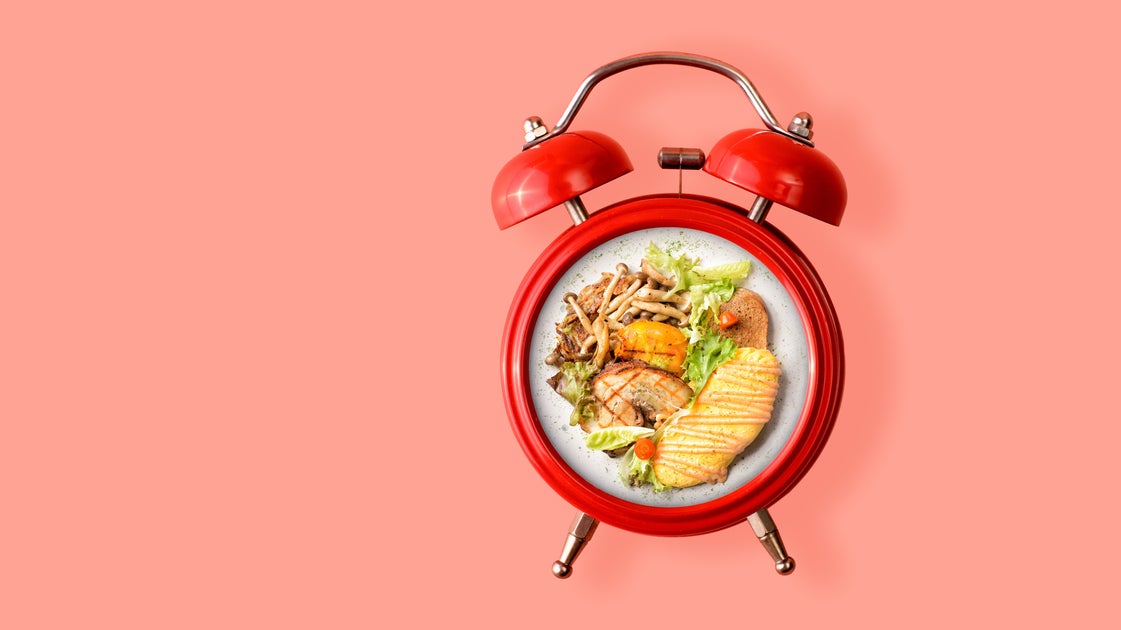
If you grew up eating three square meals a day, you probably tried to minimize snacks in between. But recent research shows that after age 40, eating multiple smaller meals throughout the day may benefit your brain, improving cognition and memory.
So, which is better: eating three larger meals or five or six smaller ones? Dietitians say the answer isn’t so simple, and what’s right for you depends on several factors.
“Eating frequency is a complex topic, so advice always needs to be personalized,” Tara Schmidt, lead dietitian at the Mayo Clinic Diet, told HuffPost. “I often ask my patients and members, ‘How will this change impact what you’re eating?’ For some, increasing eating frequency could (and often does) lead to excess calorie intake, while for others it may help them meet their nutritional needs.”
Here’s what to know about how eating three large meals vs. five or six smaller meals could impact your brain health.
Which eating approach is better for brain health?
“It depends on context,” Angel Planells, a Seattle-based registered dietitian nutritionist and spokesperson for the Academy of Nutrition and Dietetics, told HuffPost. “The brain relies heavily on a steady supply of glucose, oxygen and key micronutrients.”
A 2024 study published in the Journal of Nutrition found that people over age 40 who ate about five or six times a day had better cognition and memory than those who ate less frequently.
However, Planells said, “Eating frequency alone doesn’t guarantee better cognition,” and what you eat matters.
Some people — such as those who need to consume more calories or who can’t eat much at one time — typically “do better with more frequent eating,” Schmidt said. “Anywhere from three to five eating episodes a day can be reasonable for most people.”

Here are the brain-centric advantages of eating multiple smaller meals:
-
Reducing blood sugar swings. Since the brain needs a steady supply of glucose for energy, eating large (especially carb-heavy) meals can cause blood sugar spikes followed by drops, which may affect focus, brain processing speed, and mental energy, Planells said. Smaller meals may minimize these blood sugar swings.
-
Improving nutrient distribution. The body better utilizes certain nutrients crucial for brain health, like B vitamins and omega-3 fatty acids, “when spread throughout the day, rather than loaded once or twice,” Planells added.
- Reducing cognitive fatigue. Large meals divert blood flow to digestion, possibly making you feel sluggish and affecting alertness, Planells said. “Smaller meals may blunt that effect for some individuals.” Eating more frequently can also prevent long fasting gaps, which may impair attention and memory.
This doesn’t mean eating three square meals a day isn’t good for brain health, though. This eating approach can be just as beneficial as long as the meals are not too big, balanced (with protein, fiber, healthy fats and carbs), and timed to support your individual energy needs, Planells said.
What you eat matters just as much as (if not more than) frequency
Whichever approach you prefer, make sure that your meals are well-balanced, Charlotte Cervantes, didactic program in dietetics director and assistant professor in the Allied Health, Kinesiology and Sport Sciences at Southeast Missouri State University, told HuffPost. This means ensuring that your macronutrient and micronutrient needs are met, which benefits all of your body’s systems, including your brain.
“Look at each eating episode as an opportunity to provide key nutrients from the various food groups like fruits, vegetables, whole grains, healthy fats and protein,” Schmidt said.
For brain health, Schmidt and Cervantes recommend the MIND Diet, or Mediterranean-DASH Diet Intervention for Neurodegenerative Delay. It combines two well-known eating patterns, emphasizing nutrient density, which benefits your overall health and may help protect against cognitive decline, Schmidt said.
The MIND Diet recommends eating vegetables, berries, whole grains, nuts and seeds, beans, seafood (including fatty fish), poultry, and extra-virgin olive oil — and limiting ultra-processed foods, including those high in sugar, salt and saturated fat, Cervantes said.
“While more studies are needed, current research suggests that adherence to the MIND diet may meaningfully reduce the risk of Alzheimer’s disease,” she said.
If you want to try eating smaller, more frequent meals, Cervantes said to decide how you want to space them out so you’re fueling your body throughout the day and not missing out on nutrients.
Then, she said to determine how many calories each meal should include. Start with your total daily calorie needs (use an online calculator to help) and divide that number by the total number of meals. For instance, if your daily caloric requirement is 2,400 and you plan to have six meals, each one should be 400 calories.
“You could certainly adjust and allocate more calories to some meals and less to others: if you enjoy a larger breakfast or like to enjoy a bigger dinner with family, then you could consume fewer calories at your other meals,” Cervantes said.
Should you eat three bigger meals vs. several smaller meals?
“The best approach is individualized, focusing on nutrient quality, protein distribution and metabolic stability — not meal count alone,” Planells said.
As long as you’re meeting your overall nutrient and calorie requirements, eating three large meals or several smaller ones is a personal choice based on your schedule and “capacity for fueling,” he said.
“We want to make sure we consume an adequate amount of calories (without consuming too many), and that those calories come from foods packed with vitamins, minerals, healthy fats, fiber, protein, and phytochemicals,” Cervantes said.
“If an individual is overwhelmed by large plates of food, then I would suggest smaller, more frequent meals,” she said. “On the other hand, if someone prefers the traditional, ‘three square meal’ approach and their nutrient needs are being met, then I generally wouldn’t challenge them on it.”