



Cheaper ones demand power and elbow grease to get going, and they also can be less consistent with their power supply, said Gabriel Erde-Cohen, technical supervisor at We Clean Heat Pumps heating, ventilating and air conditioning services in Westminster West, Vermont.
“A more inexpensive, accessible model is hard to start, run and maintain, [and] there are also usually power fluctuations that come from a cheaper generator that can mess with electronics and appliances in the home.”
Erde-Cohen also said that while more expensive generators may have automatic starts and stops and smoother power flow, they need to be run regularly for maintenance, demanding extra gas or propane just to stay working well.
How to choose a generator for your home
Before scrolling through different home generators, De Loach says the first step is to calculate your usage.
“You actually have to reverse engineer the process,” he said. “Figure out what your critical moves [are] in the event of a storm, what is a necessity. If you have a four-bedroom house and two freezers and grandma on a breathing machine, then you need something that can handle a heavy load or something that’s going to run almost indefinitely.”
To help with your calculations, Willeford said a home air conditioner requires 1,000 watts of energy for every 600 square feet of home. “A gas heater uses around 1,000 watts and electric portable heaters use around 2,000 watts,” Willeford added. “A refrigerator uses between 350-750 watts.” Add up everything you plan to use, and you’ll need at least that much running power.
Beyond wattage, Willeford encourages you to think about your living needs and demands. “Next is noise. If you live in the country, a loud generator may not be an issue. But if you live in a neighborhood, there are many quiet generator models,” Willeford says. “Then, you will need to decide which fuel source: gas, diesel or propane.”
To help you find your backup power source, the experts shared their favorite home generators and a couple of power banks for good measure.
HuffPost may receive a share from purchases made via links on this page. Every item is independently selected by the HuffPost Shopping team. Prices and availability are subject to change.
Gas and propane portable generators

DuroMax 12,000-watt gas or propane generator
For high-intensity power with less risk of stenches or mess, De Loach recommended generators that are able to run on either gasoline and propane. "Gasoline stinks and it can be messy," De Loach said. "Propane is less fume-y; there's no spillage."
De Loach suggested DuroMax gas- or propane-powered generators that are intended for heavy loads, like running lights, AC and a refrigerator at the same time. With 9,500 running watts, an electric start and three different types of outlets (heavy-duty, twist lock and household), this generator rivals the power you'd get from a permanent unit, in a portable form.
Promising review: "We have had to put it into use because of Hurricane Irma, and based on our experience so far we would say it is a great tool for your storm preparations. We have been running on the generator now for five full days and it has held up quite well. We started off on propane from a 100-lb tank and that lasted from mid-day Sunday when the power went out to Tuesday afternoon when we noticed the condensation at the very bottom of the propane tank (~47 hours). That utilization is running a ~2,600sqf 5br home with 4 ton 16 seer A/C and a well and two refrigerators (we have on-demand electric water heaters that are on a separate box and are too high a load for the generator so they are not included). One note about the A/C, as noted in another review, the lights do dim when the A/C kicks on because the startup load is pretty heavy on a 4 ton A/C unit. The A/C runs quite well. We have ensured we do not use the A/C at the same time as the stove based on the load." — FL-Reviewer
Portable gas generators

Generac 4,500-watt portable gas generator
When it comes to portable gas generators, De Loach suggests the brand Generac. "They're well known for their portable generators, permanent home backup and commercial generators," he said.
This portable generator has 3,600 running watts, meaning it's ideal for running smaller appliances in an emergency (though reviews say it can power a fridge and WiFi). It has five home outlets and a nine-hour run time. Because it's uncovered, it will produce sound.
Promising review: "I start this up every month run it for 3-5 min. Never in disaster mode yet but just in case, I need something to run my refrigerator, freezer and wifi I'm good." — Jane Kaczmarek

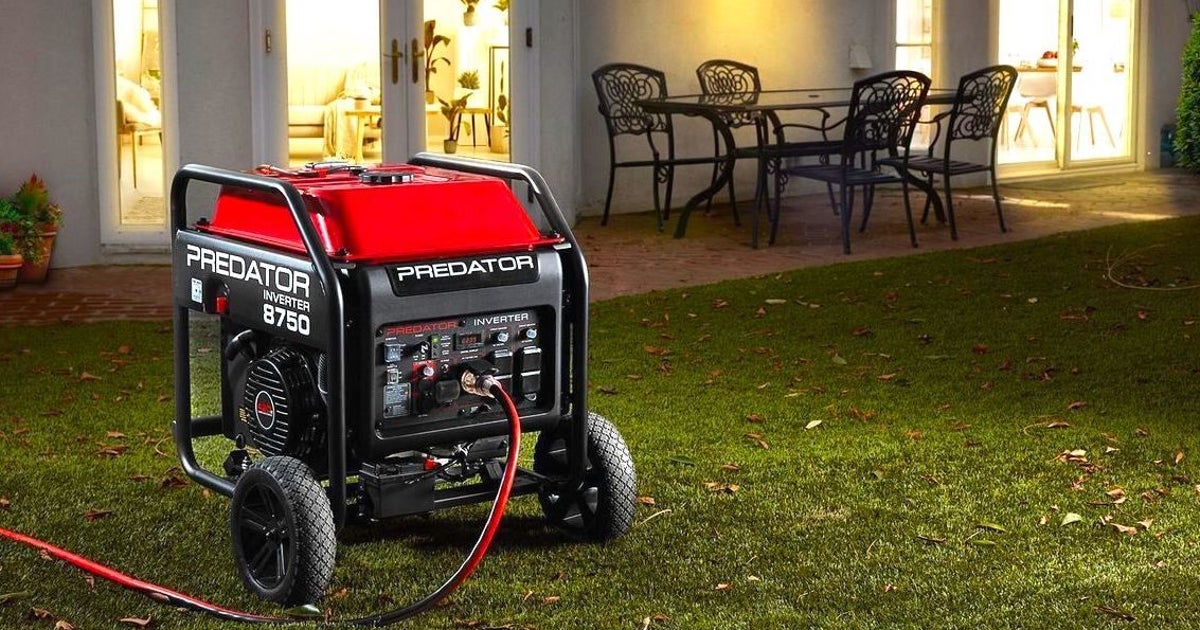
Harbor Freight Tools' Predator 4,375-watt gas powered portable generator
Small but mighty, the 4,375-watt gas-powered portable generator can run up to 16 hours at a 50% load. It has 3,500 running watts, so it's ideal for running a few larger home appliances, though it may not be ideal for delicate electronics that are prone to short-circuiting, such as phones and laptops. It has two outlets and is uncovered, so it's likely a little noisy, though reviews say you can position it away from your home.
Promising reviews: "It is running a refrigerator, portable air conditioner, lights and fans. Runs 12 hours before we refuel it however it is noisy as it is supposed to be." — Robert
Portable power banks

Editor's choice: Jackery 300 portable power station
10 or 12 gauge heavy duty extension cords

Champion 25-foot 10-gauge locking outlet cord
"If you're gonna be running extension cords from your refrigerator all the way outside to your house, you need really heavy-duty extension cords," he said. "If you use something that's undersized for the distance and the load you're gonna put on it, those extension cords could burn up and damage your appliances. You want to oversize all the extension cords."
This 25-foot cord plugs into a generator with a 30-amp locking outlet and gives you four 20-amp household outlets to plug your appliances into.