


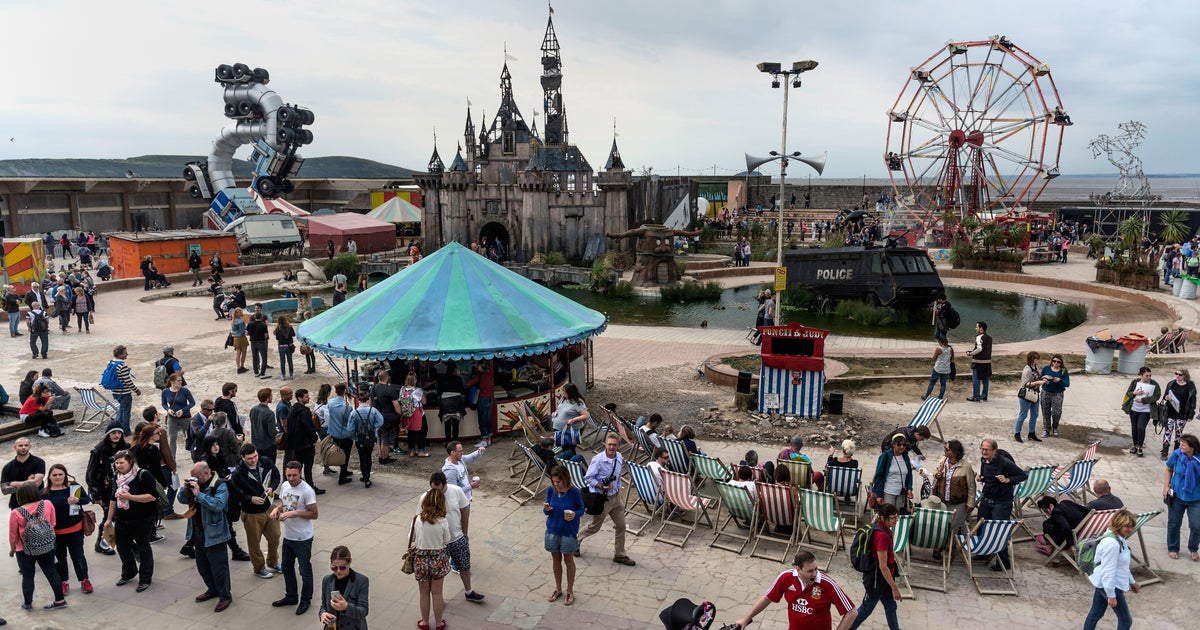

The swathes of street art, spoof fairground rides, derelict Cinderella castle and notoriously grumpy staff are all history ― Banksy’s so-called Dismaland is no more.
In the place of the “bemusement park,” currently, is a real-life fun fair.

However, Funland, like Dismaland, certainly isn’t the final chapter in the story of the Tropicana ― the 10,000-square-foot former swimming pool complex in Weston-super-Mare, southwest England.
The Huffington Post visited the site to see how it’s changed since elusive artist Banksy opened his sinister take on a theme park there on Aug. 21, 2015 ― and to find out how it’ll be further developed in the coming years.
This is what Dismaland visitors saw during the five-week pop-up show:

The iconic sign has gone, replaced with one for Funland.

The airport-style cardboard security checking area has been scrapped.

Remnants from the show remain, but the space is now vacant.

This nightmarish fairytale castle has been torn down:

And there’s a working fun fair in its place.

Banksy’s “Grim Reaper” exhibit has disappeared.

It’s now the “Reaper Bar” and performance space.

The main exhibition hall was a focal point of the Banksy show.

It’s now empty.

This room hosted artist Jimmy Cauty’s dystopian model village:

It’s also now just a shell.

The spoof fairground attractions have been taken away.

And have been replaced by these functioning ones:

And there’s also a ton of new street art by local artists. Click below for a slideshow of their work:
What’s Next For Dismaland?
Dismaland technically ceased to exist as soon as Banksy and the exhibition’s 58 featured artists left the Tropicana in September and sent their construction materials to the makeshift refugee and migrant encampments near Calais, France.
The site was then returned to its owners at the local authority, North Somerset Council, which had shut down the 1930s-built outdoor swimming pool complex in 2000 due to low visitor numbers.
Here’s what the Tropicana looked like in its heyday:
“It had become very weary and needed a lot of capital investment,” said Mark MacGregor, who is in charge of transforming the venue on behalf of the authority.
Several major companies made proposals to redevelop the site, but all fell at the final hurdle and none made a serious commitment.
“So we were left with a derelict building,” MacGregor said. “We tried to knock it down but there was an outcry as it’s in a conservation area. The U.K. government stepped in and we had to keep it.”
Video shows the derelict Tropicana before Banksy took it over:
Faced with either putting resources into upkeep for a shuttered venue or breathing some life back into the space, the authority opted for the latter and renovated the cafe area. That, MacGregor said, was coincidentally when Banksy’s team first approached the authority about taking over the facility for the artist’s curated show.
“It blew us away,” he said.
After the exhibition ― which attracted about 150,000 visitors and pumped a reported £20 million, or about $26 million, into the local economy ― ended, it was essential for the North Somerset Council to seize on the global publicity it had gained.
“But we couldn’t conjure up another Dismaland,” MacGregor said. “So we made a commitment to finding a future for the site that would hopefully be financially self-sustaining.”