


For the first time since Apollo 17 in 1972, humans have left Earth’s orbit.
Four astronauts aboard the Orion spacecraft on the Artemis II mission performed a “trans-lunar injection burn” Thursday evening, setting the capsule on course for a lunar flyby.
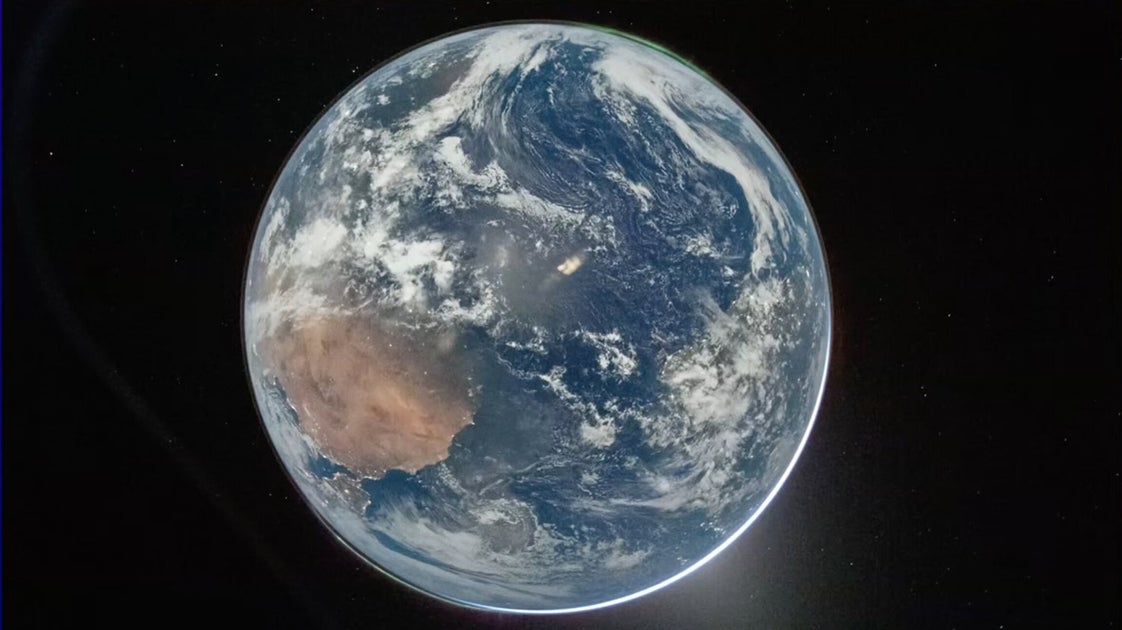
As the capsule began hurtling away from Earth, Artemis II Commander Reid Wiseman snapped some breathtaking photos.
In one image, Earth appears as a perfect sphere, bathed in blues and browns and swirled with clouds. A green aurora is even visible in the north:

The second image shows Earth peeking through the window of the capsule, a vibrant dot in the cold black of space.

As of Friday morning, Orion was moonbound at a speed of 4,084 mph, and 93,000 miles away from Earth. Readers can track the mission in real time here, via NASA’s website.
The spacecraft will fly by the far side of the moon at an altitude between 3,000 and 9,000 miles, venturing further into deep space than any human has gone before. For comparison, the Apollo missions were around 70 miles from the moon’s surface.
More stunning photos are sure to come. The astronauts are expected to do a lunar flyby on Monday, April 6, and will take high-resolution photos of features on the far side of the moon that have never been seen directly by humans.
CORRECTION: This article has been amended to clarify that specific features of the far side of the moon have not been seen by humans, but that prior missions have orbited the moon and seen its far side.