


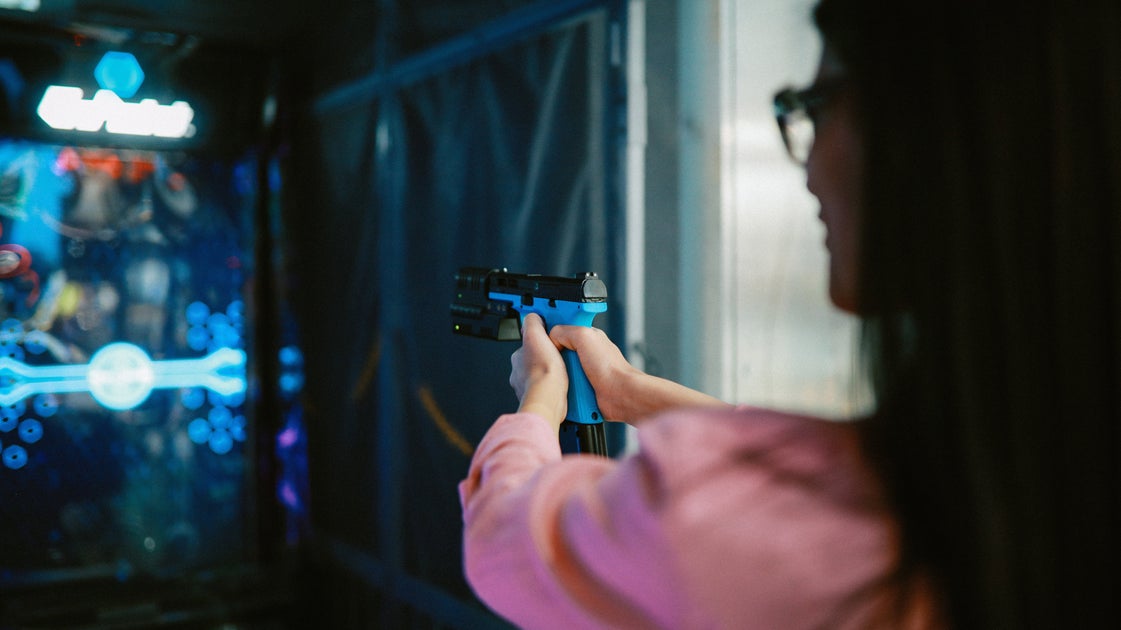

Predictably, she’d stay locked in for the first 15 seconds, then hop to the next game with her dad while I tried to “get our money’s worth” — which is how this grown woman ended up fully committed to a toddler arcade challenge.
Insert me, 5’10”, on my knees, shooting crabs, aiming at their little plastic bodies. Each blast of air earned points. The faster I pushed them back, the more I scored. Then the game stopped.
As I backed up, I could feel the adrenaline spike that pushed me, a proud anti-gun American, to empty my “clip” on plastic crustaceans. I was all in. My brain craved more.
Then it hit me: The machine wasn’t neutrally fun. The lesson came through loud and clear: This game was a cleverly designed lesson about power. It was dopamine served in short, violent bursts.
As I knelt, plastic trigger in hand, I was taken back to a sobering memory. Fourteen years ago, I was a student-teacher in Washington, D.C. One day, as I monitored the playground, I watched as Latinx toddlers reenacted ICE raids and deportations. I came to realize that they were imitating their real lives. It was devastating.
Dramatic play, when children repeat scenarios and situations they see in real life, is vital and fuels early childhood development. Children typically cook or play Mommy and Daddy. My daughter’s favorites are cashier and hairdresser. Regardless of the activity, dramatic play supports the development of language, social-emotional growth, creativity and problem-solving through storytelling and role-negotiation.
As a former educator, I can tell you that shooting games offer none of that. The narrative is singular: me versus them. The rewarded skills are mechanical, not creative. There is no collaboration, no storytelling, no emotional processing. Just aim, fire, repeat.
Watching my toddler mimic trigger motions reminded me that American children grow up in a culture saturated with gun violence. From an early age, it’s normalized as thrilling, packaged as entertainment.
Then we act surprised by the real-world consequences, including the proliferation of mass shootings across the country.
Most recently, the young people at Brown University have become part of the 393rd mass shooting incident in the U.S. this year. Brown is one data point in a country that has normalized gun violence so thoroughly that even children are implicated — not just as victims, but as participants.
In November, the country was reminded of the early ages of gun violence when a jury awarded a Virginia teacher $10 million after her 6-year-old student shot her. The verdict briefly captured national attention, but it also pointed to deeper truths: that in much of this country, firearms are stored within reach of children, often unsecured. This, compounded with lax federal gun safety laws, creates a dangerously fragmented safety system — leaving prevention to a patchwork of state policies and parental discretion.
“Brown is one data point in a country that has normalized gun violence so thoroughly that even children are implicated — not just as victims, but as participants.”
This is a uniquely American problem. This month, Australia also experienced a mass shooting. In contrast to the U.S., it’s the first one in almost 30 years. Over the past three decades, Australia dramatically tightened firearm laws, restricted access to semi-automatic weapons and implemented rigorous licensing. They are set to tighten their current restrictions, including, possibly, limiting the number of guns per person.
Meanwhile, in the U.S., the shooting at Brown and the $10 million verdict in Virginia will be discussed as separate stories and isolated incidents — one about campus safety, the other about a school administrative or parental failure. But they are connected by the same throughline: a country that has allowed guns to seep into every age and stage of our lives.
Parents are left to navigate raising children in a country where simulated violence is brushed off as harmless fun, even as real violence escalates around us. And we’re doing our best.
I know I can’t control every exposure my toddler will encounter. There will be more parties and video games than I can count. But I can slow down. I can pay attention. I can ask what a game is teaching, not just whether it’s entertaining.
For parents of toddlers — and for all parents — that work starts earlier than we’re comfortable admitting. It begins in playrooms and arcades, in the toys we buy and the behaviors we reward. It begins when we notice what makes our kids light up, and what those moments are training them to enjoy.
Because when a 6-year-old can shoot a teacher and the number of mass shootings exceeds the number of days in a year, the problem isn’t confined to one classroom or one campus. It’s systemic.
And until we confront how early that normalization begins, we will keep reacting to the outcomes — instead of interrupting the cycle at its sources.
Julienne Louis Anderson is a proud mom working in the public safety sector. She is also a fellow of The OpEd Project in partnership with the National Black Child Development Institute.
Do you have a compelling personal story you’d like to see published on HuffPost? Find out what we’re looking for here and send us a pitch at pitch@huffpost.com.