


Typically, we’d expect an actor to get lots of offers after their “big break,” like how “Titanic” made Leonardo DiCaprio an instant A-lister or how “The Wolf of Wall Street” catapulted Margot Robbie’s career.
However, for many actors, a breakout role doesn’t always lead to a major breakthrough in the industry. For others, the well of opportunity may dry up sooner than they expected it to. In both cases, actors can often attribute their lack of job offers to factors like racism, ageism, or typecasting.
Here are 17 actors who opened up about struggling to find a job after their “big break”:
1.
After wrapping "Everything Everywhere All At Once," Ke Huy Quan "could not land a single job, not even one callback." He also lost his health insurance after not booking any roles in 2021.

Allyson Riggs /© A24 / Courtesy Everett Collection
However, after the movie premiered, he started getting offers from some of Hollywood's biggest producers.
On SiriusXM's The Jess Cagle Show, he said, "Our movie came out in March. And in April, I got a call from Kevin Feige, asking me to join the MCU family. And I was so touched, and I, I was like, all that time when, when nobody wanted me, and he was one of the most powerful producers on the planet, says, 'Hey, we want you to be in Loki Season 2.'"
On SiriusXM's The Jess Cagle Show, he said, "Our movie came out in March. And in April, I got a call from Kevin Feige, asking me to join the MCU family. And I was so touched, and I, I was like, all that time when, when nobody wanted me, and he was one of the most powerful producers on the planet, says, 'Hey, we want you to be in Loki Season 2.'"
2.
Nearly four decades into her career, Michelle Yeoh found that "as you get older, the roles get smaller" and "you start getting relegated to the side more and more."

A24 / Courtesy Everett Collection
Everything Everywhere All At Once broke that cycle by casting her in the lead.
She told the LA Times' podcast The Envelope, "The first thing is you feel like, 'Finally, thank you. You guys [the directors] see me, you guys really see, and you're giving me the opportunity to show that I'm capable of doing all this.' ... All at once, it was very emotional because this means that you are the one who's leading this whole process, who's telling the story."
She told the LA Times' podcast The Envelope, "The first thing is you feel like, 'Finally, thank you. You guys [the directors] see me, you guys really see, and you're giving me the opportunity to show that I'm capable of doing all this.' ... All at once, it was very emotional because this means that you are the one who's leading this whole process, who's telling the story."
3.
After her Oscar-winning performance in "West Side Story," Rita Moreno felt that "Hollywood really took a break from [her]." She turned down any stereotypical roles she was offered, and the fact that she wasn't getting more substantial parts "absolutely broke [her] heart."

United Artists Courtesy Everett Collection
She told BuzzFeed, "I was offered some gang-type movies on a much lesser scale. I remember taking my Golden Globe and my Oscar and just saying, 'I'm never gonna do those kinds of parts again. I just won't.' And I showed them. I didn't work in a movie for seven years."
4.
Mena Massoud beat 2,000 other actors for the leading role in "Aladdin" (2019), which made $1 billion at the box office. Afterwards, months later, he hadn't "had a single audition since 'Aladdin' came out."

Daniel Smith / © Walt Disney Studios Motion Pictures / courtesy Everett Collection
He told Daily Beast, "I'm kind of tired of staying quiet about it. I want people to know that it's not always dandelions and roses when you're doing something like Aladdin. 'He must have made millions. He must be getting all these offers.' It's none of those things."
5.
For Bella Thorne, it was "really hard to get a job" after her Disney Channel series "Shake It Up" ended in 2013. Casting directors didn't want to see her "because they were like, 'She's a Disney actress.'"

Bruce Birmelin / © Disney Channel / Courtesy: Everett Collection
She told the Happy Sad Confused podcast, "It was like starting back at the bottom and working my way up all the way again."
6.
After winning an Academy Award for "Monster's Ball" in 2002 (which made her the first and, so far, only Black actor to win Best Actress), Halle Berry didn't receive offers in a way her white peers might, and she often had to take certain parts in order to provide for her children.

Lions Gate/Courtesy Everett Collection
She told Entertainment Weekly, "It was surprising. Because I thought they were going to just back up the truck and drop them off at my house, right? When you have a historic win like that, you think, 'Oh, this is going to fundamentally change.' It did fundamentally change me, but it didn't change my place in the business overnight. I still had to go back to work. I still had to try to fight to make a way out of no way."
7.
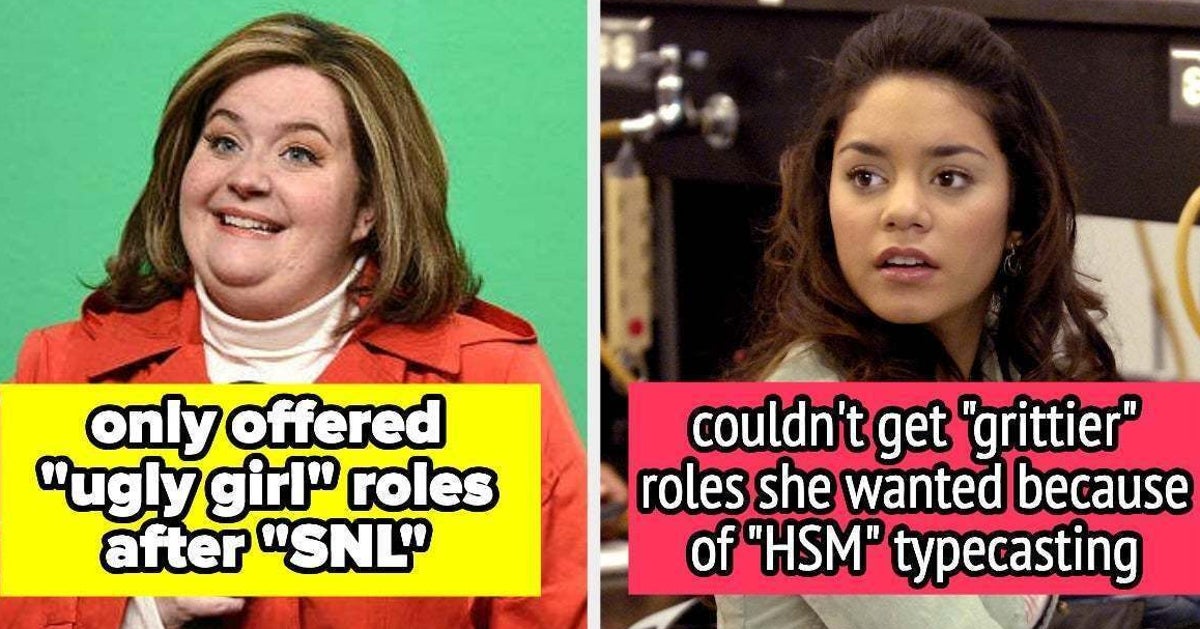
Aidy Bryant rose to prominence as a cast member on "Saturday Night Live," but, outside of the show, she was only offered roles that portrayed fat characters offensively, such as "an ugly girl [who becomes a male character's] prison wife."

Nbc / NBCU Photo Bank / NBCUniversal via Getty Images
She told Adweek, "I remember being like, 'Oh, they think that this is a fun thing for me, and it's so insulting.' Those were some of the moments where I was like, 'Is this what it is in Hollywood? I think I might have to write for myself...'"
She did, indeed, opt to write roles for herself, co-creating and casting herself as the lead in the TV series Shrill.
She did, indeed, opt to write roles for herself, co-creating and casting herself as the lead in the TV series Shrill.
8.
When "The Kissing Booth" dropped on Netflix, Jacob Elordi practically became famous overnight. Afterwards, he moved to LA, but he "wasn’t booking jobs" and ended up living in his car for a time.

Netflix / Courtesy Everett Collection
He told GQ, "I think I had — I don’t know, $400 or $800 left in my bank account — and Euphoria was my last audition before I went home for a little while to make some money and recuperate."
While he was filming the pilot for Euphoria, a producer noticed his living situation and helped him get a hotel room.
While he was filming the pilot for Euphoria, a producer noticed his living situation and helped him get a hotel room.
9.
After playing Alice Cullen in the "Twilight" franchise, Ashley Greene had moments of saying to herself, "Why is this so hard?" because "you come off a high like 'Twilight' and then you get dropped back down to reality."

She told Lucky magazine, "Twilight has given me something to skyrocket off of. But now that it's ending, there's so much work to be done. And if I don't do it, then Twilight's all I'm ever going to be known for, as great as it is."
10.
Brenda Song rose to fame as London Tipton on the Disney Channel series "The Suite Life of Zack & Cody" and "The Suite Life on Deck." Afterwards, she struggled to get roles that were written for Asian actors. When she tried to get an audition for "Crazy Rich Asians," the production refused because "[her] image was basically not Asian enough."

Danny Feld/©Disney Channel / courtesy Everett Collection
She told Teen Vogue, "I said, 'This character is in her late to mid-20s, an Asian American, and I can't even audition for it? I've auditioned for Caucasian roles my entire career, but this specific role, you're not going to let me do it? You're going to fault me for having worked my whole life?' I was like, 'Where do I fit?'"
11.
For Jeff Cohen, who played Chunk in "The Goonies," puberty was "a career ender" because he was "transforming from Chunk to hunk, and [he] couldn't get roles any more."

Warner Bros./Courtesy Everett Collection
He told the Daily Mail, "It was terrible. My first love was acting, but puberty had other ideas. It was a forced retirement. I didn't give up acting. Acting gave me up."
12.
Fresh on the heels of her "Jurassic Park" success, Laura Dern guest-starred on "Ellen" as the titular character's love interest in her coming out episode. Due to anti-gay backlash, Laura didn't book anymore work for a year.

Touchstone Television/ Courtesy Everett Collection
She told Vulture, "[The episode was the] greatest thing I could’ve ever been part of, honestly. An incredible honor...I didn't think twice about it. It was a great opportunity. And then, the calls started coming in once I'd said yes, from a couple of advisers in Hollywood who were out gay men, [telling me] to not do it. A lot of people in my life really worried. And I was like, 'This is ridiculous.' This is where I grew up in a bubble and didn't realize we weren't there yet or something. The first time I became aware was, Oprah [who played Ellen's therapist] and I were having a snack, and suddenly, a flood of cops swarmed the set and the stage while we were rehearsing. They're like, 'There's been a bomb threat, we're sweeping the stage.' And they start literally rushing us off the stage."
13.
At 38, Liv Tyler felt like "a sort of second-class citizen" in Hollywood because the only roles for women her age were "usually the wife or the girlfriend."

Jc Olivera / Getty Images
She told More magazine, "It's not fun when you see things start to change. When you're in your teens or 20s, there is an abundance of ingenue parts, which are exciting to play."
14.
Early in her career, Jessica Alba struggled to find roles because casting directors "couldn't figure out [her] ethnicity." She had to try out for "exotic" roles because "they were like, 'You're not Latin enough to play a Latina, and you're not Caucasian enough to play the leading lady, so you're going to be the 'exotic' one.' Whatever that was."

Jeffrey Mayer / WireImage / Via Getty
She told PopSugar, "That was kind of a weird thing to wrestle with, because I never had to look at myself that way or stick myself in a bucket. So, I was more determined to be a leading lady to show that girls can look like me, and we can be leading ladies."
15.
After a successful run in her teens and 20s, Julia Stiles "was feeling like nobody knew what to do with [her]" and "was sort of jumping from job to job that [she] wasn't really connected to, and worried about where [her] career was going."

Buena Vista / courtesy Everett Collection
She told Daily Beast, "But a movie like Hustlers to me is such an affirmation that, like, I have a place in the film industry, and stories that I’m interested in are being told."
16.
Though Vanessa Hudgens was thankful for "High School Musical," it "closed people's minds up as to which characters [she] could portray," and, for a while, she was "kind of struggling and fighting for these roles that [she] just desperately wanted."

Fred Hayes / © Disney Channel / Courtesy: Everett Collection
She told Untitled magazine, "They only saw me as Gabriella Montez, and I love that character, but there's so much more to me than just that. It was hard, and it was a struggle, but then again, life is always a struggle. Having a career will always be a struggle. You’ll always have to fight for what you want. Definitely crossing over and being able to tackle these grittier parts was a challenge, but I feel like I've done it! It's a whole new chapter!"
17.
And finally, Chris Owen became well-known for his role as Chuck Sherman in "American Pie." However, he later worked as a server in a sushi restaurant because "life doesn't always go the way you planned."

Universal / courtesy Everett Collection
He told the NY Daily News, "I love acting, and this job lets me stay in the fight."