


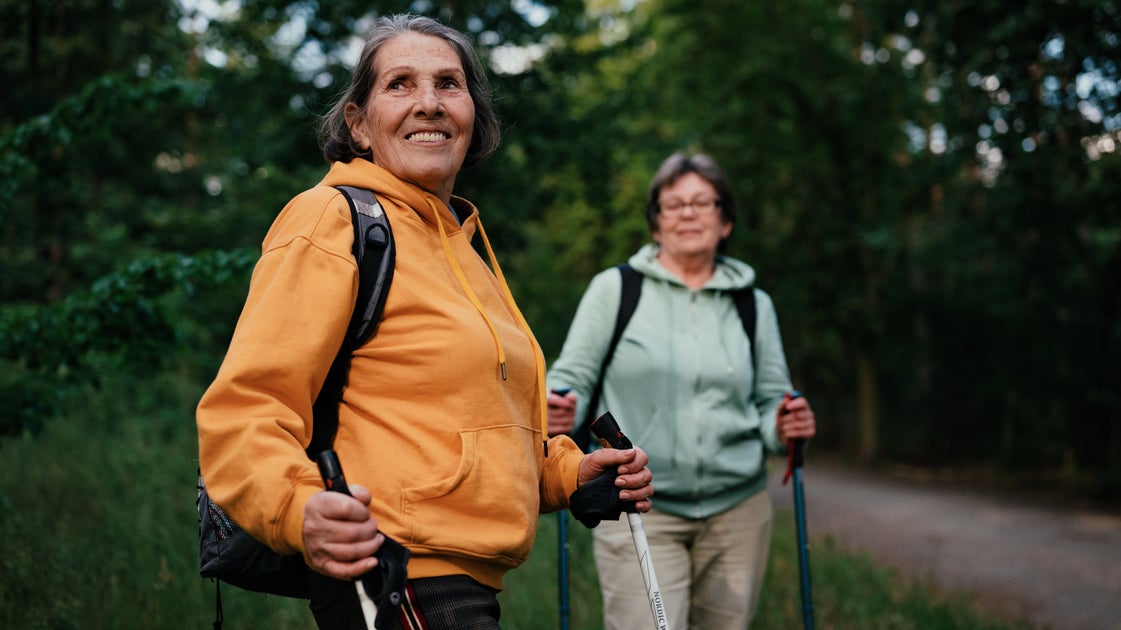
Forget 10,000. Taking just 3,000 steps each day is enough for older adults to get protection against Alzheimer’s disease, according to research. The condition is the most common type of dementia, which is an umbrella term that describes conditions and diseases that impact cognition and memory.
In a 2025 study published in the journal Nature Medicine, researchers from Harvard University followed roughly 300 adults, ages 50 to 90, for up to 14 years. The adults all had early signs of Alzheimer’s disease in their brains but did not yet have cognitive changes that affected their day-to-day lives.
Participants wore pedometers to monitor their daily step count. Adults who took at least 3,000 steps daily had lower buildup in their brains of tau proteins, which are known to develop as Alzheimer’s progresses. Tau proteins are also linked to cognitive decline, according to Science Daily.
When compared to sedentary people, those who took 3,000 to 5,000 steps each day slowed down cognitive decline by an average of three years. Participants who took 5,000 to 7,500 steps daily slowed it down by seven years on average. All in all, walking 3,000 to 7,500 steps daily seemed to show the most benefit.
People who walked more than 7,500 steps each day did not see any additional brain health perks. Researchers used brain scans and cognitive tests over the course of the study to measure the amount of tau proteins and amyloid-β proteins (which also build up in the brains of those with Alzheimer’s disease) in participants’ brains.
There are limitations to this research. Participants were mostly white and highly educated; it’s not known whether these same results would apply to other groups of people. The pedometers also did not capture the full breadth of someone’s exercise history, how fast or slow someone was walking, or if they took part in exercise that didn’t increase step counts such as swimming or weight lifting.
Other research says that walking faster, rather than slower, can be even better for your brain health.

Other lifestyle changes can help lower your risk of dementia or slow cognitive decline.
Lacing up your walking shoes has major benefits for multiple systems in your body — your cardiovascular system, your musculoskeletal system and, of course, your brain, as this research suggests.
Dr. Benjamin Rosenstein, an assistant professor at the University of Minnesota Medical School, agreed and previously told HuffPost that movement is an important way to protect your brain health, and there are other things you can be doing, too.
Rosenstein also recommends eating a nutritious diet such as the MIND diet, which is inspired by the Mediterranean diet, or the DASH diet, which works to lower blood pressure.
Both meal plans prioritize high fruit and vegetable intake, lean proteins and foods that are low in saturated fat.
Controlling factors like high cholesterol and high blood pressure also help protect your cognition by ensuring your brain gets the oxygen and blood flow it needs.
How much you sleep also impacts your dementia risk. “People need to sleep adequately because the brain renews itself during deep sleep and lowers its concentration of beta amyloid, which is the toxic protein that contributes to the development of Alzheimer’s disease,” Dr. James Ellison, a geriatric psychiatrist at Jefferson Health in Philadelphia, previously told HuffPost.
Learning new skills throughout life and older age is also encouraged, whether that’s picking up a new language, a different hobby or an unfamiliar task at work.
“There is some literature suggesting that individuals who have more lifelong challenge, whether that is challenging work, more challenging or intellectually stimulating hobbies, or being an autodidact and just learning and going through things, that there does tend to be a lower risk for developing dementia later in life,” Dr. David Gonzalez, a neuropsychologist at Rush University Medical Center in Chicago, previously told HuffPost.
If you do notice signs of dementia or Alzheimer’s disease, which include memory loss, trouble following conversations, difficulty doing multiple tasks at once or forgetting words as you’re speaking, you should talk to a doctor.
“It’s so hard not to be afraid of something when most people have someone in their life that has been touched by this disease, and it feels as though your future risk of it ... is out of your control. But the things that we’ve talked about, all lifestyle changes that can be done better that are in our control,” Dr. Christina Prather, director of the Division of Geriatrics and Palliative Medicine at the George Washington University School of Medicine & Health Sciences, previously told HuffPost.
As the U.S. population ages, data shows that the number of people with dementia will go up. Fourteen million adults are expected to have dementia in 2060 compared to about 7 million adults now.
Genetics and other hereditary factors can increase someone’s risk of developing the disease, so it is not all in your control. Exercise, a nutritious diet, good sleep hygiene and more can all help lower your risk or slow the progression if you are diagnosed.