
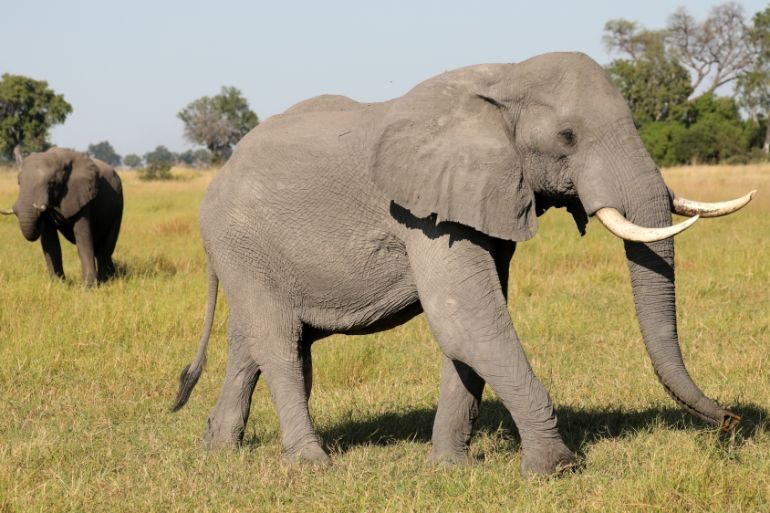
Conservationists have raised the alarm about the Botswana government’s decision to increase its annual trophy-hunting quota for elephants, reigniting a debate over how the country should manage the world’s largest elephant population.
Botswana, a largely dry nation which is home to 2.3 million people, has more than 130,000 elephants, nearly one-third of all elephants in Africa. The African continent is home to some 415,000 elephants of the world’s 460,000 elephants. The rest of the world’s elephants are in Asia.
Recommended Stories
list of 3 items- list 1 of 3Botswana to hold auction of elephant hunting licences
- list 2 of 3Botswana investigating ‘mysterious deaths’ of elephants
- list 3 of 3Calls for ending Botswana’s ban on big-game hunting
In 2019, the government lifted a five-year moratorium on elephant hunting to keep the elephant population in check and help generate revenue from trophy hunters for rural communities.
However, conservationists and scientists warn that the sharp increase in quota numbers recently announced risks undermining the long-term health of elephant populations as well as exacerbating human-wildlife conflict.
Speaking to Al Jazeera, Oaitse Nawa, founder of the Botswana-based Elephant Protection Society (EPS), said the number of elephants being hunted is “too high” and called on the government to revisit this issue.
What is Botswana’s new trophy-hunting quota?
A preliminary government draft indicates that the quota for trophy hunting for 2026 has been raised to 430 elephants, up from 410 in 2025.
Trophy hunting refers to the practice of legally killing wild animals, such as elephants, lions, and rhinoceroses, and taking a highly valued part of their bodies, such as a tusk or horn. Botswana’s expansive, yet sparsely inhabited landscapes have long drawn foreigners who wish to visit its wildlife.
The move reflects Botswana’s general approach to the conservation of elephant herds.
In 2014, the country imposed a complete ban on trophy hunting but reversed that decision five years later, saying elephant numbers had risen too high and were threatening farmers’ livelihoods.
Now, the government allocates annual hunting quotas for more than a dozen species, including elephants, rhinos, and hippopotamuses.
Other African nations, including Namibia, Zimbabwe and Tanzania, also have trophy-hunting quotas to manage their elephant and other wildlife populations.
Why does the government allow trophy hunting?
The Botswana government argues the practice is important to keep the population of the large animals in check, as they are increasingly coming into conflict with humans. Climate change and logging, which encroach on elephants’ natural habitat and food sources, have also forced elephants to look elsewhere for habitat and food.
As a result, elephants in several African countries have been known to enter private homes and villages, trampling crops, eating stored grain, and damaging homes, fences and water infrastructure.
Botswana’s former President Mokgweetsi Masisi last year slammed the German government for a proposed ban on the import of elephant parts.
Many other countries, including Australia, Belgium, Canada and the Netherlands, have also imposed restrictions on the import of parts of endangered species, including elephants, lions, hippopotamuses and rhinos.
Masisi said Germans should “try living among elephants”. He claimed that an explosion in the number of the mammals roaming his country had produced a “plague”.
Moreover, the Botswanan government says regulated hunting provides a highly valuable revenue stream. Earlier this year, Minister of Environment Wynter Mmolotsi said the country earned more than $4m from the sale of hunting licences in 2024, compared with $2.7m in 2023, and that this money was used to support conservation and community-led projects.
Depending on the animal being hunted, hunting licences can cost up to $10,000.
Is trophy hunting a serious threat to elephants?
Amy Dickman, a professor of wildlife conservation and director of WildCRU at the University of Oxford, said, while trophy hunting may be “contentious”, it is not a key threat to any species, including elephants, and that “revenue from legal hunting helps maintain large areas of wildlife habitat and can be very important for local people”.
“Botswana – the leading country in the world for large mammal conservation – has a thriving elephant population, and both the government and local communities need to see financial benefits from that presence,” she told Al Jazeera.
“They have long used trophy hunting to generate some of those benefits, and their sovereign decisions should be trusted and respected.”
Al Jazeera contacted Botswana’s Department of Wildlife and National Parks and the Ministry of Environment for comment, but received no reply.
What do critics of the trophy hunting quota system say?
According to Will Travers, cofounder and executive president of Born Free, a wildlife charity, Botswana’s expanded elephant trophy hunting quota “raises deep biological concerns”, however.
“Biological, because, as the name suggests, trophy hunters target individual animals they regard as ‘trophies’ … in the case of elephants, those with the largest tusks, the mature males,” he told Al Jazeera in an emailed statement.
“These long-lived ‘elders’ are repositories of vital survival knowledge within elephant society, are desired by female elephants, and can successfully reproduce, passing on their genes well into old age. They are targets for poachers and trophy hunters, adding even more pressure on this tiny demographic of animals, which some estimate may represent just 1 percent of Botswana’s national elephant herd.”
Moreover, experts also say that removing elephants changes how they behave, which can actually exacerbate, rather than reduce, conflict with nearby human communities.
“Since the community lives within the same environment as these animals, they often encounter wildlife that can be provoked or become aggressive,” EPS’s Nawa told Al Jazeera.
“When people go to the fields or search for their cattle, they may come across breeding herds of elephants, and that’s where problems begin.
“The elephants may run up and down, destroying crops as they flee for their lives – after all, they are living creatures, and if they feel threatened, they must escape,” he added.
What are the alternatives?
Nawa said authorities should take a community-based approach to controlling interaction with elephants by equipping residents with the knowledge and skills to live alongside wildlife.
“The community need to be trained since they live with these animals,” he said, about what to do “if they encounter an elephant”.
Nawa also said communities in Botswana could benefit from living alongside elephants if the government adopts a policy that links water boreholes to tourism. “We can have lots of boreholes and tourism facilities around those boreholes, whereby the community can benefit directly from the funds,” he said.
Citing the example of one local elephant resort, he explained that they drilled a lot of boreholes around the area, attracting elephants, and many people come to watch the elephants “at a very close range”.
“The community needs to be educated to understand the role of elephants, especially in the ecosystem, and how they can benefit directly from elephants without killing them or obstructing them,” he added.