

President Volodymyr Zelenskyy has taken his quest for more arms and Ukrainian membership of powerful Western institutions to a sprawling summit of European leaders.
But as Zelenskyy renewed his demands for NATO and EU membership at the European Political Community meeting in Moldova, held on Thursday, leaders of the military alliance gathered in Norway and were divided on Ukraine’s call.
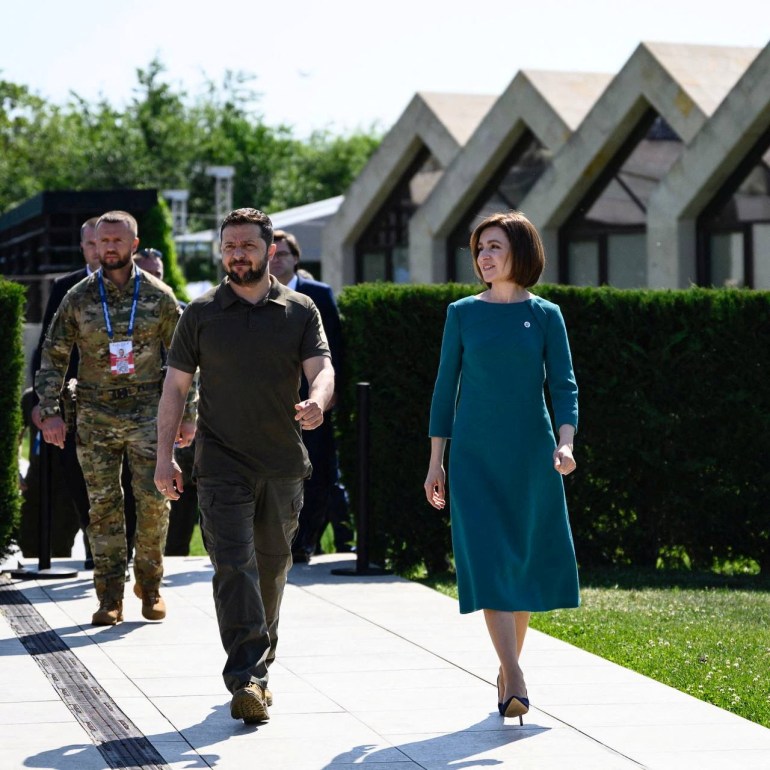
He called for more European support on the ground, which he said is saving lives and “literally accelerating peace”.
Recommended Stories
list of 4 items- list 1 of 4Ukraine receives bodies of 1,000 soldiers from Russia
- list 2 of 4‘You’re not human:’ A legal limbo for Russian nationals in Ukraine
- list 3 of 4Russia-Ukraine war: List of key events, day 1,435
- list 4 of 4How drone warfare has changed in Ukraine
According to Al Jazeera’s Stefanie Dekker, reporting from the summit, Zelenskyy was the first foreign leader to arrive at the venue, a move unlikely “by chance”.
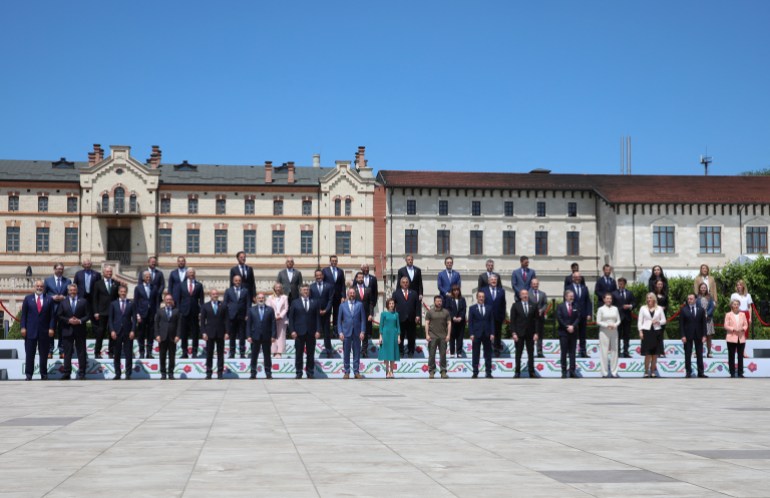
Dutch Prime Minister Mark Rutte told the summit, “Our meeting today in Moldova speaks volumes. The country borders on Ukraine and here, the Russian threat is palpable.”
German Chancellor Olaf Scholz, French President Emmanuel Macron and UK Prime Minister Rishi Sunak also attended.
Meanwhile in Norway, divisions among NATO allies about the speed of Kyiv’s accession became apparent, only weeks before a decisive mid-July summit in Vilnius.
“All allies agree that Moscow does not have a veto against NATO enlargement,” NATO chief Jens Stoltenberg told reporters foreign ministers gathered in Oslo, seeking to dispel any signs of discord.
NATO agreed in 2008 that Ukraine would eventually join the alliance but leaders have so far stopped short of taking steps, such as giving Kyiv a membership action plan, that would lay out a timetable for bringing Ukraine closer to the military pact.
While Kyiv and its closest allies in Eastern Europe have called for concrete steps to bring Ukraine closer to membership, Western governments, such as the United States and Germany, have been wary of any move that might take the alliance closer to war with Russia.
Lithuania’s Foreign Minister Gabrielius Landsbergis said Kyiv had suffered two invasions while waiting for an answer from NATO for 14 years.
“It is high time that we actually sit down and find a very concrete answer as to how Ukraine is going to move closer to NATO and when they become a member of the alliance,” he said, a call that was echoed by his Estonian counterpart.
Other allies, such as Germany and Luxembourg, stressed the risks should NATO rush to let Kyiv join, while Hungary stated clearly Ukraine’s NATO accession could not be on the agenda at the upcoming summit.
“NATO’s open door policy remains in place, but at the same time, it is clear that we cannot talk about accepting new members [who are] in the midst of a war,” German Foreign Minister Annalena Baerbock said.