
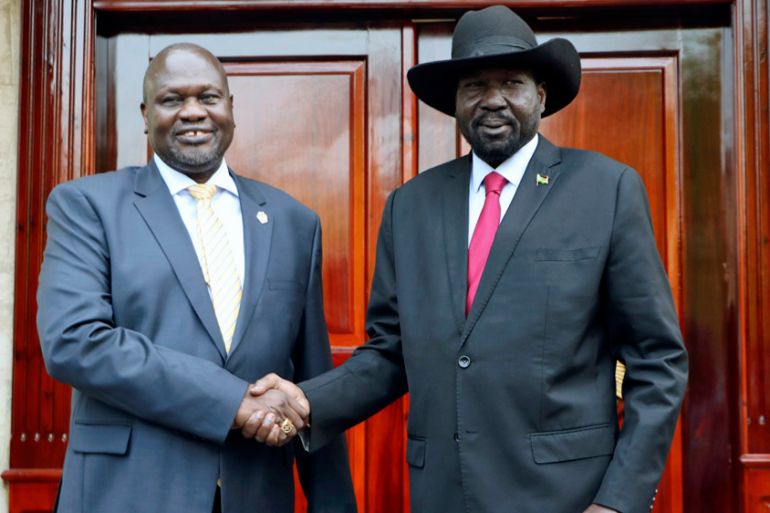
South Sudan’s President Salva Kiir has ordered military officers loyal to his vice president, Riek Machar, to be officially integrated into a unified command of the army, state media has said.
The move announced on Tuesday is a central pillar of the peace process in the Horn of Africa nation.
Recommended Stories
list of 4 items- list 1 of 4South Sudan charges VP Machar with treason, murder over military attack
- list 2 of 4Is Sudan’s war merging with South Sudanese conflicts?
- list 3 of 4UN warns of conflict in South Sudan amid reports of VP Riek Machar’s arrest
- list 4 of 4South Sudan: President Kiir, VP Machar agree to resume talks
Kiir and Machar’s forces signed a peace agreement in 2018 that ended five years of civil war. But implementation has been slow and the opposing forces have clashed frequently over disagreements about how to share power.
Fighting has flared in recent weeks.
But following pressure from donors and international partners, the two men met on April 8 and Machar submitted a list of officers to be absorbed into the security services.
Machar’s Sudan People’s Liberation Movement/Army in Opposition (SPLM/A-IO) had suspended its participation in the peace deal’s oversight mechanisms last month, citing attacks by government forces.
SPLM-IO spokesman Lam Paul Gabriel said the “long-awaited” move would help stop continuing ceasefire violations in different parts of the country.
“The SPLA-IO welcome the decision”, he said. “We just hope that this will pave a way forward to the completion [of] the unification process,” Lam told Reuters.
The next step is to graduate SPLM/A-IO soldiers from training centres and integrate them into the army, but details remain to be worked out, including the precise ratio of troops from each side.
In July, Pope Francis is expected to visit the country to help smoothen the peace process.
Beginning in 2013, South Sudan’s five-year civil war, often fought along ethnic lines, killed an estimated 400,000 people, triggered a famine and created Africa’s biggest refugee crisis since the 1994 genocide in Rwanda.